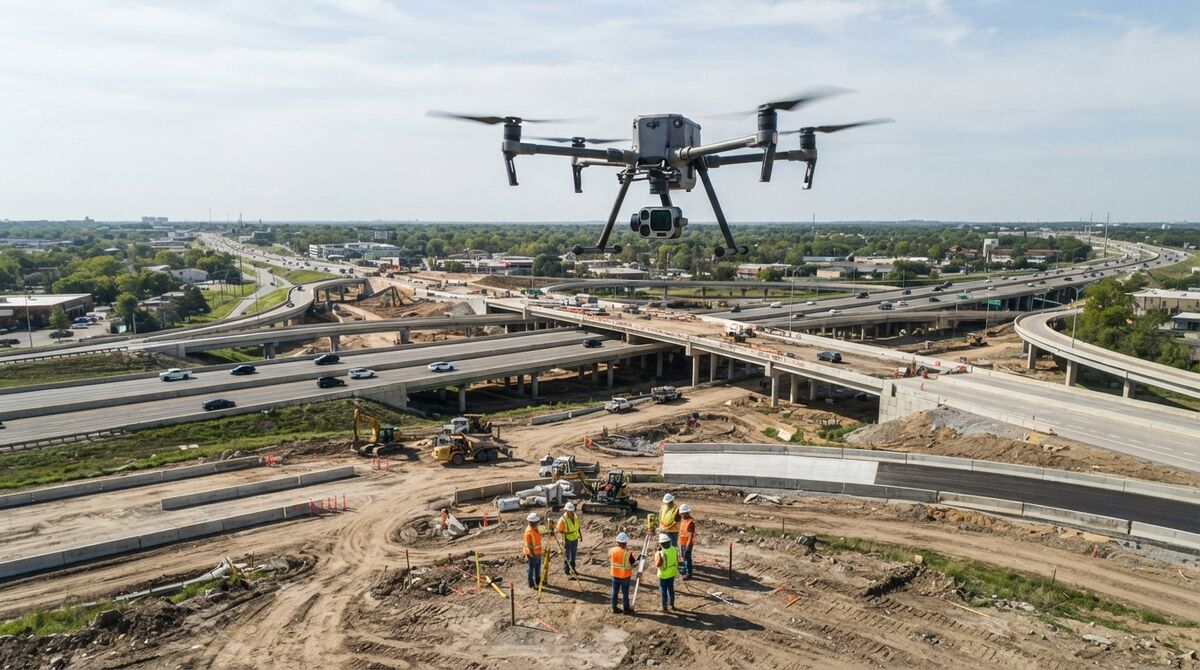
DJI Matrice 4E mapping is one of the smoothest enterprise workflows available today because both the Matrice 4E and its thermal sibling, the 4T, are fully supported by the SkyeBrowse Flight App. Photogrammetry is the practice of building measurable 3D geometry from overlapping imagery, and videogrammetry does the same from continuous video. This guide covers the automated Flight App workflow, how the 4E and 4T differ, a direct Matrice 4E versus Matrice 350 RTK comparison for photogrammetry, and where the thermal 4T earns its place in public safety.
Key Takeaways
- Both the Matrice 4E and 4T are fully supported by the SkyeBrowse Flight App, including WideBrowse grid mode with Cross Grids and Side Scan.
- The Matrice 4E wide camera is a 20MP 4/3 CMOS with a mechanical shutter, the mapping workhorse; the 4T swaps in a 640x512 thermal camera for public safety.
- With RTK the Matrice 4 series delivers 1 cm horizontal positioning, enabling survey-grade absolute accuracy when paired with proper control.
- The Matrice 4E is a lighter, integrated, lower-cost alternative to the modular Matrice 350 RTK for standard mapping missions.
- The 4T thermal camera makes it the tool of choice for crash scenes at night, search and rescue, and fire operations.
Contents
- Does SkyeBrowse support the DJI Matrice 4E and 4T?
- What is the Matrice 4E mapping workflow with the Flight App?
- Matrice 4E vs 4T: which should you buy?
- Matrice 4E vs Matrice 350 RTK for photogrammetry?
- Why is the Matrice 4T built for public safety mapping?
- FAQ
Does SkyeBrowse support the DJI Matrice 4E and 4T?
Yes. Both the Matrice 4E and 4T are fully supported by the SkyeBrowse Flight App with the required compatible controller. That includes SkyeBrowse orbit mode for scenes under an acre and WideBrowse grid mode with Cross Grids and Side Scan for larger sites, giving you automated capture end to end.
Full Flight App support matters because it removes manual piloting from the equation. You define the area, pick orbit or WideBrowse, and the drone flies the pattern while recording. The Matrice 4 series joins the Mavic 3E and 3T, the M30 series, and the M300 and M350 on the fully supported list, always with the required controller. Confirm your exact controller pairing on the supported drones list before a job.
For teams standardizing an enterprise fleet, the automated capture and cloud pipeline together are what our UAV mapping software overview calls the shortest route from flight to deliverable.
What is the Matrice 4E mapping workflow with the Flight App?
Open the SkyeBrowse Flight App, choose orbit mode for a small subject or WideBrowse grid mode for a large area, and the Matrice 4E flies the mission automatically while recording video. The clip and its telemetry upload to app.skyebrowse.com, where cloud processing returns a 3D model, orthomosaic, and point cloud in minutes.
The 4E wide camera is a 20MP Type 4/3 CMOS sensor with a mechanical shutter, which freezes each frame without the rolling-shutter smear that fast forward flight can introduce (DJI Matrice 4 Series). For large-area jobs, WideBrowse Cross Grids fly two perpendicular passes so vertical surfaces and building edges reconstruct cleanly, while Side Scan adds oblique coverage. Every mission lands in the same browser-based drone mapping software, so no desktop processing seat is needed.
Because the Matrice 4 series carries RTK, positions record at 1 cm horizontal accuracy, so with proper ground control the model reaches survey-grade absolute accuracy as defined by the ASPRS standards (ASPRS). Recommended capture settings are a fixed exposure, locked white balance, 75 to 80 percent overlap in grid mode, and an altitude chosen for your target GSD in the table below.
| Altitude | Approx. GSD (4E 20MP wide camera) |
|---|---|
| 60 m | 1.6 cm/pixel |
| 80 m | 2.1 cm/pixel |
| 100 m | 2.7 cm/pixel |
The Flight App's Previous Flights panel saves the location, date, and time of every completed WideBrowse mission, so a crew mapping the same site week over week can reload the earlier grid boundary instead of redrawing it on every visit. That's most useful for construction progress documentation and stockpile tracking, where the survey area rarely changes but the terrain inside it does from one flight to the next.
Once a Matrice 4E model finishes processing, SkyeBrowse exports the point cloud as LAZ, the textured mesh as GLB, OBJ, or USDZ, and the orthomosaic as GeoTIFF on Lite and above, with CAD-ready DXF or GeoJSON available through the AI Site Plan tool on Premium. Those formats drop straight into GIS, CAD, and forensics software without a conversion step, so the enterprise deliverable keeps moving from flight to final report the same day.
Matrice 4E vs 4T: which should you buy?
Buy the Matrice 4E for pure mapping and survey work, because its 20MP 4/3 mechanical-shutter wide camera is built for photogrammetry. Buy the Matrice 4T when you need thermal, because it carries a 640x512 radiometric thermal camera for search and rescue, fire, and night operations. Both share the same airframe and RTK.
The split is about the wide camera. The 4E prioritizes visible-light mapping with its 20MP 4/3 sensor and DNG raw output, which gives the reconstruction the cleanest possible texture. The 4T trades that for a 48MP 1/1.3-inch wide camera plus the thermal sensor, sacrificing a little mapping resolution to gain heat vision.
If your work is construction progress, stockpiles, or topographic survey, the 4E is the clear pick. If you are a public safety or utility team that also needs to find people, hotspots, or energized equipment in the dark, the 4T does both jobs from one aircraft. DJI also sells the M4TD variant, which SkyeBrowse supports the same way, provided it's flown with the required DJI RC Pro remote. For agencies weighing hardware against the software that processes it, the law enforcement drone guide frames the decision around mission type.
Matrice 4E vs Matrice 350 RTK for photogrammetry?
For standard photogrammetry the Matrice 4E is more efficient: it is lighter, integrated, lower cost, and ready to fly with a mapping camera built in. The Matrice 350 RTK is a heavy-lift modular platform whose advantage is swappable payloads, including LiDAR and higher-end mapping cameras. Choose the 4E for turnkey mapping and the 350 for payload flexibility.
The Matrice 4E ships with its mapping camera fixed to the airframe, so there is nothing to configure and less that can go wrong on site. It weighs about 1,219 grams and flies up to 49 minutes, which means less transport bulk and faster setup than a cased M350. For a crew that maps the same kinds of sites every day, that turnkey design wins on cost per flight.
The Matrice 350 RTK earns its keep when the payload changes. Its interchangeable mounts accept survey cameras and LiDAR units the 4E cannot host, and its heavier lift supports missions the 4 series is not built for. If you already run an M350 or are comparing the two for a survey program, our dedicated guide to the best mapping software for the DJI Matrice 350 RTK covers that platform in depth. For most photogrammetry-first buyers, the 4E is the leaner tool.
Why is the Matrice 4T built for public safety mapping?
The Matrice 4T pairs a 640x512 thermal camera with the same RTK mapping capability as the 4E, so a single flight can map a scene and reveal heat signatures. That makes it ideal for crash reconstruction at night, search and rescue, and fire operations where a visible-light camera alone falls short.
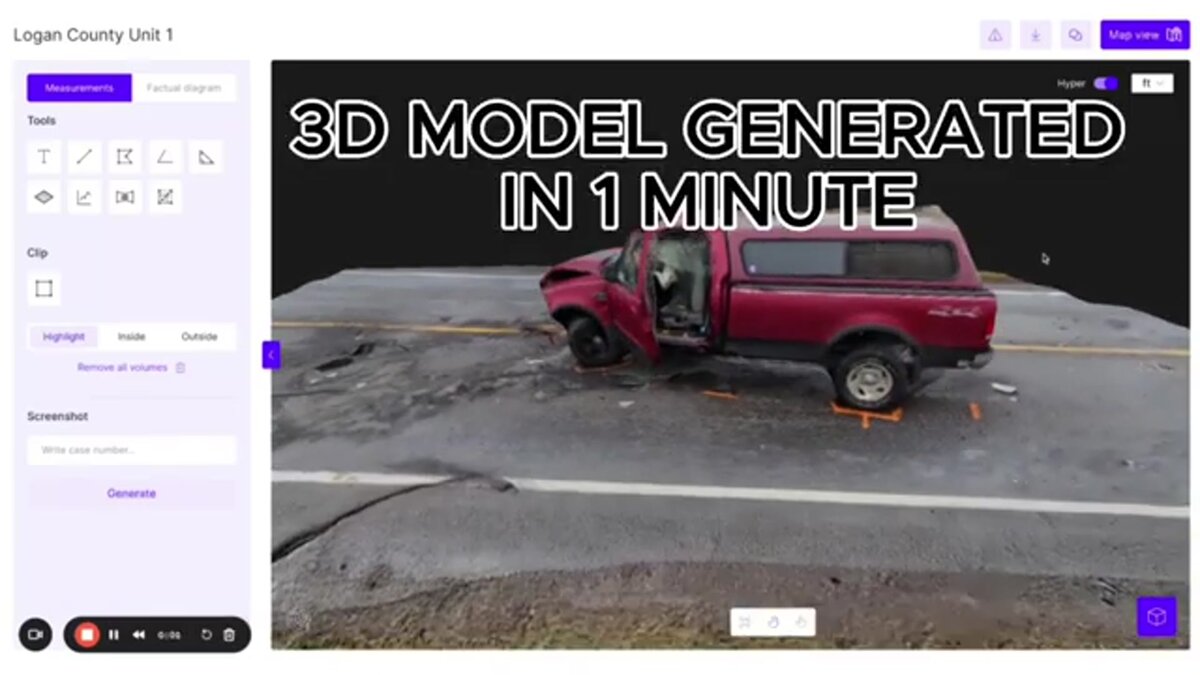
Public safety mapping often happens in bad conditions, at night, or against the clock. The 4T thermal sensor reads temperatures across a wide range, so a search and rescue team can locate a person by heat while the same aircraft captures the survey-grade video that becomes a court-ready 3D scene. Investigators get a measurable model of the roadway without keeping lanes closed for a laser scanner.
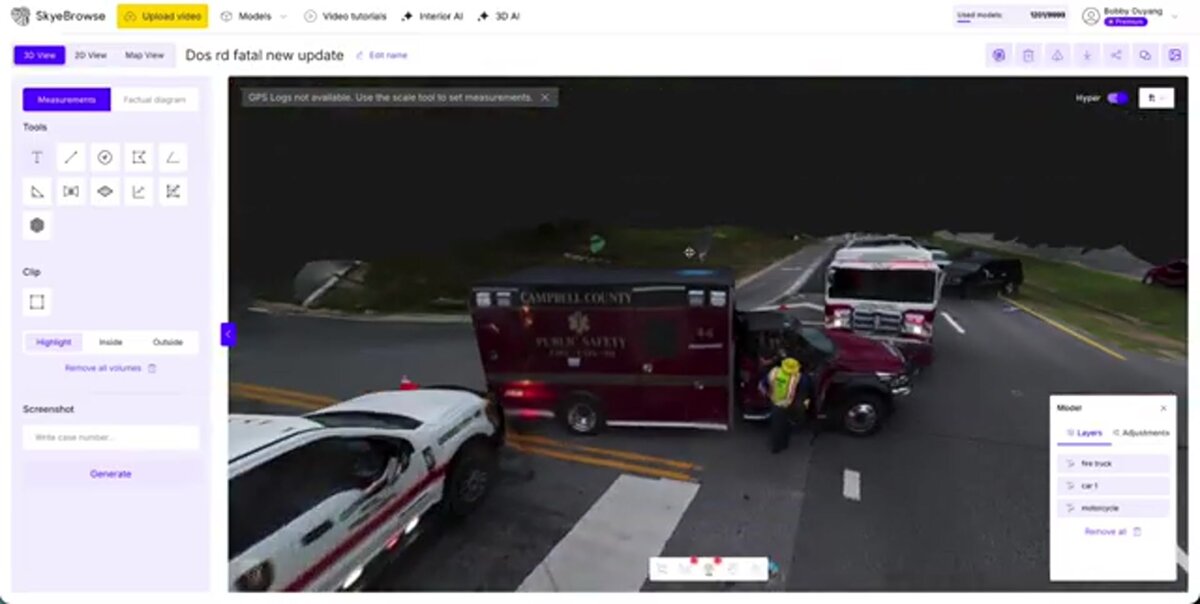
In the viewer, the Thermal Mapping toggle lets investigators overlay the 4T's heat data on the reconstructed scene, and Night Ops mode supports processing in low-light conditions as long as the site has some source of lighting. For departments assembling a court-ready file, the Premium Factual Diagram tool turns the same model's measurements and annotations into a scaled PDF with a top-down overview and compass, so the thermal flight and the evidentiary paperwork don't require separate software.
That combination shortens the entire evidence workflow: fly once, capture both spectra, and have a model teams can measure before they leave. Our first responder drone guide details how agencies pair the 4T with rapid cloud processing. Departments that fly the earlier Phantom line for reconstruction can compare the upgrade path in our Phantom 4 mapping guide.
FAQ
Does SkyeBrowse support the DJI Matrice 4E and 4T?
Yes. Both are fully supported by the SkyeBrowse Flight App with the required compatible controller, including WideBrowse grid mode with Cross Grids and Side Scan. Confirm your controller pairing on the supported drones list.
Should I buy the Matrice 4E or the Matrice 4T for mapping?
Buy the 4E for pure mapping and survey work because of its 20MP 4/3 mechanical-shutter wide camera. Buy the 4T when you need a 640x512 thermal camera for public safety, search and rescue, or fire and inspection at night.
Is the Matrice 4E or Matrice 350 RTK better for photogrammetry?
The Matrice 4E is a lighter, lower-cost integrated mapping drone ready to fly out of the box. The Matrice 350 RTK is a heavy-lift modular platform for interchangeable payloads and LiDAR. For standard photogrammetry the 4E is more efficient; for payload flexibility the 350 wins.
Upload your first video free. Create a free SkyeBrowse account, upload a drone video, and get a 3D model processed in the cloud. Freemium organizations that have never had a paid plan can get their first full Commercial model for $5 (normally $24.99), with every Commercial tool, every export, and 90-day storage.