Photogrammetry, the science of deriving precise measurements and 3D models from overlapping photographs, has moved from surveying labs onto the devices in your pocket. Whether you need to scan an object with your phone, map a construction site by drone, or document a crash scene for court, there is a photogrammetry app built for that workflow. This guide compares the leading mobile and desktop options for 2026 with pricing verified directly on each vendor's site, clarifies what each category can and cannot do, and explains where capture apps end and cloud processing platforms begin.
The best photogrammetry app depends on your subject. For phone-based object and room scanning, Polycam, Scaniverse, and RealityScan lead in 2026 on iPhone, while KIRI Engine and RealityScan are the strongest picks on Android. For professional site-scale work, drone mapping, rooftops, accident scenes, construction sites, SkyeBrowse pairs a dedicated drone capture app with cloud processing to produce measurement-accurate 3D models from video. Pix4D and Agisoft Metashape remain the desktop standards for survey-grade output. Most mobile photogrammetry apps offer a free tier for evaluation, with paid plans adding high-resolution mesh and point-cloud exports; Polycam's Pro plan has been discontinued and replaced by Basic and Business tiers.
Key Takeaways
- Polycam discontinued its Pro plan in 2026. Current plans are Free, Basic ($30/month), Business ($400/year per user), and custom Enterprise.
- Scaniverse's on-device scanning stays free with no subscription; new Plus ($20/month) and Pro ($50/month) tiers add cloud processing credits for 360-camera splats and commercial licensing.
- RealityScan from Epic Games is completely free on both iOS and Android, including for commercial use, making it one of the only zero-cost options with no export ceiling.
- SkyeBrowse is the only platform in this roundup that provides both a dedicated drone capture app (SkyeBrowse Flight App) and a cloud processing engine in one workflow.
- For professional deliverables, point clouds, georeferenced orthomosaics, measurement-accurate meshes, a cloud or desktop processing platform is required regardless of which capture tool you use.
Contents
- What is a photogrammetry app and how does it work?
- Which mobile photogrammetry apps are worth using in 2026?
- What is the best photogrammetry app for iPhone and Android?
- How do drone photogrammetry apps compare to mobile scanning?
- Which desktop and cloud processing platforms produce professional-grade outputs?
- How do the top photogrammetry apps compare on capture method and platform support?
- What do the free tiers actually include?
- What does each photogrammetry app cost in 2026?
- How did we evaluate these photogrammetry apps?
- FAQ
What is a photogrammetry app and how does it work?
A photogrammetry app uses overlapping images or video frames to reconstruct a three-dimensional model of a subject through a process called structure from motion (SfM). The app identifies common points across frames, triangulates their positions in space, and builds a dense point cloud that can be converted into a mesh or orthomosaic map. Modern mobile versions leverage phone hardware, LiDAR scanners on iPhone Pro models, depth cameras, and motion sensors, to speed up the reconstruction. Desktop and cloud platforms perform the same SfM computation but with greater processing power and higher output resolution.
The American Society for Photogrammetry and Remote Sensing (ASPRS) publishes the foundational accuracy standards that professional photogrammetric outputs are measured against. Those standards distinguish between map scales and positional accuracy classes, a reminder that "3D model" means different things depending on whether the output will be used for a social media post or as courtroom evidence.
On the mobile side, Apple ARKit (iOS) and Google ARCore (Android) provide the underlying sensor fusion frameworks most apps use to turn images into 3D models in real time. ARKit's LiDAR-based Scene Reconstruction API, available on iPhone Pro and iPad Pro, allows apps like Polycam and Scaniverse to generate mesh geometry in real time rather than waiting for post-processing. Android apps without LiDAR access, including KIRI Engine and RealityScan Mobile, instead reconstruct geometry from a sequence of standard photos, trading real-time preview for broader device compatibility.
For a broader look at software in this space, see our guide to photogrammetry software.
Which mobile photogrammetry apps are worth using in 2026?
Polycam, Scaniverse, and RealityScan lead the mobile 3D scanning app category in 2026. All three run on iOS and Android, support LiDAR-accelerated capture on compatible iPhones, and export industry-standard mesh formats. Polycam adds a drone photo mode for aerial captures, Scaniverse focuses on room-scale and object scanning with a free on-device tier, and RealityScan is Epic Games' free entry with no paid mobile tier at all. KIRI Engine and magicplan round out the category as strong Android-first and floor-plan-specific alternatives.
Polycam processes photos and LiDAR scans directly on-device for quick previews, then optionally sends data to its cloud for higher-quality meshing. Its drone mode accepts a folder of overlapping images from any camera-equipped drone, which makes it a lightweight option for pilots who already fly DJI or Autel hardware. Polycam streamlined its pricing in 2026: the Pro plan is gone, and the lineup is now Free, Basic ($30/month or $150/year), Business ($400/year per user), and custom Enterprise, verified on poly.cam/pricing as of July 2026.
Scaniverse, now under Niantic Spatial, keeps its classic on-device scanning and gaussian-splat generation free with no subscription required. Niantic Spatial added Plus ($20/month) and Pro ($50/month) tiers in 2026 that layer in credit-based cloud processing for 360-degree camera input and commercial usage rights, verified on nianticspatial.com as of July 2026. It does not support drone photogrammetry workflows on its own; it is a handheld and BYOD (bring-your-own-data) capture tool that can ingest drone or 360-camera footage through its enterprise Capture product.
RealityScan, released by Epic Games, is free to download and use on both iOS and Android, including for commercial projects, with no in-app subscription for the mobile app. The desktop companion is also free for students, educators, hobbyists, and companies earning under $1 million in annual revenue, with paid licensing above that threshold, verified on realityscan.com as of July 2026. That makes it one of the only entries in this roundup with genuinely no-cost commercial mobile scanning.
KIRI Engine targets Android users who need photogrammetry app Android capability without an iPhone Pro. It runs on standard camera images, uses cloud GPU processing, and its Basic tier includes unlimited scans and unlimited free exports; the Pro tier ($17.99/month or $79.99/year) adds featureless object scanning, 3D Gaussian splat rendering, and faster processing, verified on kiriengine.app/pricing as of July 2026.
magicplan is a purpose-built floor-plan and interior-measurement app rather than a general object scanner. It runs on iOS and Android with the same feature set across every tier, no add-ons locked behind higher plans, starting with two free lifetime projects, then paid plans that bundle a set number of monthly project exports with a per-project overage fee (around $40 per additional project) once that allowance is used, verified on magicplan.app/pricing as of July 2026.

What is the best photogrammetry app for iPhone and Android?
On iPhone, Scaniverse, Polycam, and RealityScan are the best photogrammetry apps because they tap the LiDAR scanner on iPhone Pro models for fast, accurate object and room capture. On Android, KIRI Engine and RealityScan are the best choices since both run on standard camera photos with cloud-assisted processing and do not require Apple LiDAR. Most of these apps offer a free photogrammetry app tier, with paid plans adding high-resolution mesh and point-cloud exports. For drone-based capture on either platform, the SkyeBrowse Flight App (iOS and Android) automates the flight and feeds video straight into cloud processing.
iPhone photogrammetry benefits from dedicated hardware: the LiDAR scanner on iPhone Pro and iPad Pro models lets apps generate mesh geometry in real time rather than waiting on post-processing. That makes a mobile photogrammetry app on iPhone ideal for quick object, artifact, and interior scans. Android users without LiDAR rely on photo-based reconstruction, where KIRI Engine's cloud GPU pipeline and RealityScan Mobile's cross-platform engine close much of the gap. A free photogrammetry app tier on any of these tools is enough to evaluate quality before subscribing, though export formats and resolution stay capped on some until you upgrade, RealityScan being the notable exception with no paid mobile tier at all.
The shared ceiling for every handheld app is coverage area. Once a subject grows past room scale, a building facade, a roof, a stockpile, a crash scene, phone capture loses accuracy and a drone workflow becomes necessary. That is the boundary where a mobile scanning app hands off to a drone capture app paired with a cloud processing platform.
How do drone photogrammetry apps compare to mobile scanning?
Drone photogrammetry apps cover subjects that no handheld scanner can reach: large outdoor sites, rooftops, crash scenes, and agricultural fields. A drone captures hundreds of overlapping frames from altitude in minutes, the aerial photogrammetry approach, giving the processing engine enough coverage to produce georeferenced outputs at site scale. Mobile scanning apps are faster and require no pilot certification, but their coverage area tops out at roughly room scale before accuracy degrades significantly.
The capture side of a drone workflow typically involves a flight planning app that programs an autonomous mission and stores GPS-tagged video or photos. The SkyeBrowse Flight App is designed specifically for this role: it connects directly to supported DJI and Autel drones, automates the capture pattern, and packages the video file with embedded telemetry for immediate upload. Unlike generic flight apps that hand off raw files to a separate platform, the SkyeBrowse Flight App deposits data directly into the SkyeBrowse cloud for processing, closing the gap between capture and deliverable.
Pix4Dcatch takes a different approach on iOS: it turns a phone into a survey-grade capture device using AR guidance and LiDAR, with a free Discovery tier for basic scanning and GPS georeferencing. The Pro tier adds RTK connectivity and automatic ground control point detection, but it is typically sold bundled with hardware kits (from roughly $2,990 to $4,300 for a one-year professional license with cloud processing credits, verified via pix4d.com as of July 2026) or as an add-on to an existing Pix4D subscription, rather than as a standalone consumer purchase.
Where a generic drone mapping software pipeline requires pilots to manage separate flight, download, and processing steps, often across multiple applications, SkyeBrowse combines all three. The platform also supports video-based input (MP4, MOV) from drones already in the field, so teams do not need to re-fly previous missions.
For pilots exploring no-cost options before committing to a paid platform, our breakdown of free drone mapping software covers open-source alternatives in detail.
Which desktop and cloud processing platforms produce professional-grade outputs?
Pix4D, Agisoft Metashape, and SkyeBrowse are the three most widely used platforms for professional photogrammetric outputs in 2026. Pix4D and Agisoft require significant desktop computing power and technical configuration. SkyeBrowse offloads all processing to the cloud, so teams with a drone and a browser can generate measurement-accurate 3D models without managing local hardware or software licenses.
Pix4D dominates enterprise surveying and precision agriculture workflows. Pix4Dmapper runs on Windows and requires a high-RAM workstation for large datasets, priced from $333/month. Its companion tools span the range from PIX4Dreact ($55/month) for rapid response mapping to PIX4Dmatic ($125/month) for large-dataset photogrammetry, verified on pix4d.com/pricing as of July 2026. Outputs, point clouds, DSMs, and orthomosaics, are among the most accurate available when supported by ground control points, but the subscription cost is significant and the learning curve is steep for non-survey professionals.
Agisoft Metashape (formerly PhotoScan) is the preferred tool in academic and forensic settings. It runs locally on Windows, macOS, and Linux, supports network processing across multiple workstations, and gives users fine-grained control over every processing parameter. Like Pix4D, it assumes the user will manage their own hardware and has no built-in capture app.
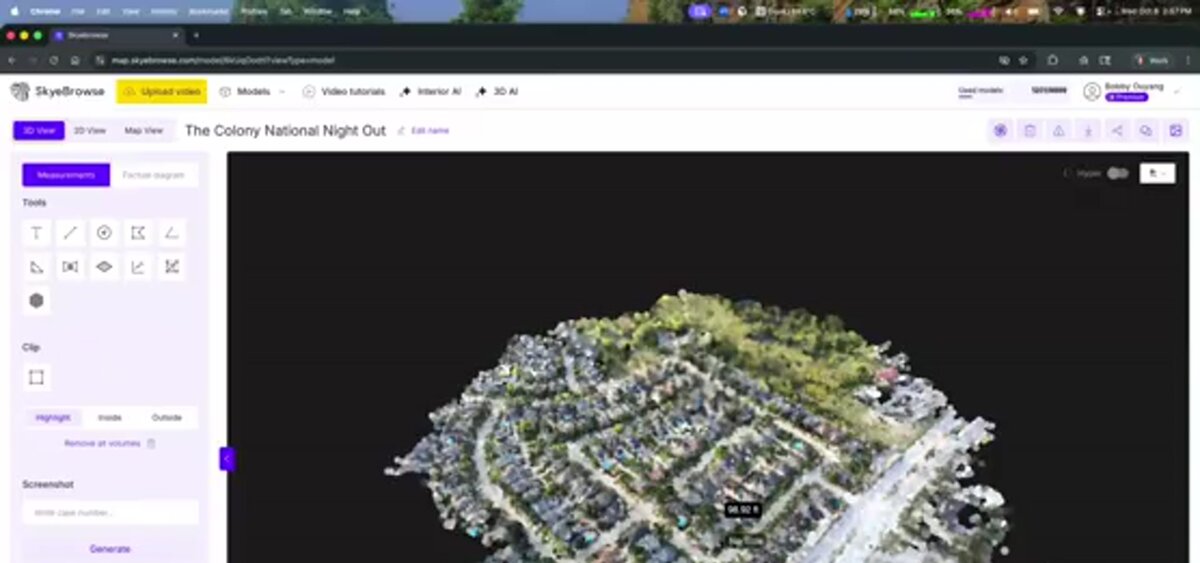
SkyeBrowse takes a different architectural approach: every computation happens on US-based AWS infrastructure at FedRAMP Impact Level 2, with full CJIS compliance support maintained for Premium subscribers, so the only hardware requirement on the user side is a drone (or a phone for interior mapping) and a device with a browser. The platform accepts video uploads directly, an important distinction when field teams need to move quickly and cannot wait for a desktop workstation to batch-process images. Accuracy scales with the processing tier selected: Lite runs roughly 2 to 6 inches, Premium reaches about 0.25 inch on 8K processing, and Premium Advanced targets about 0.1 inch on 16K processing with AI moving-object removal, so a team can match processing cost to how tight the deliverable's tolerance needs to be. Outputs include LAZ point clouds, GLB meshes, and GeoTIFF orthomosaics.
How do the top photogrammetry apps compare on capture method and platform support?
The table below separates each app's primary capture method from the platforms it runs on. LiDAR-capable apps get the fastest real-time previews on compatible iPhones; photo-based apps trade that speed for broader device compatibility, including every Android phone.
| App / Platform | Platforms | Primary Capture Method | Output Formats |
|---|---|---|---|
| Polycam | iOS, Android, Web, Vision Pro | Photos, LiDAR, drone photo sets | GLB, OBJ, USDZ, point cloud |
| Scaniverse | iOS, Android, Web | LiDAR, photos, gaussian splats | GLB, OBJ, point cloud, splat |
| RealityScan | iOS, Android | Photos, guided AR capture | 3D mesh, textured model |
| KIRI Engine | iOS, Android, Web | Photos (no LiDAR required) | OBJ, GLB, STL |
| magicplan | iOS, Android | Photos, 360 images, LiDAR (interior floor plans) | PDF, ESX, FML |
| Pix4Dcatch | iOS only | Photos, LiDAR, RTK (with hardware) | Feeds Pix4Dcloud, Pix4Dmatic |
| SkyeBrowse Flight App | iOS, Android | Drone video (MP4, MOV) | Feeds SkyeBrowse cloud |
| Pix4D (desktop) | Windows | Drone images | Point cloud, DSM, orthomosaic |
| Agisoft Metashape | Windows, macOS, Linux | Photos, video frames | Point cloud, mesh, orthomosaic |
| SkyeBrowse (cloud) | Web (all devices) | Drone or phone video (MP4, MOV) | LAZ, GLB, GeoTIFF |
Table verified as of July 2026 against each vendor's own site.
For a direct feature comparison between SkyeBrowse and Polycam, see SkyeBrowse vs Polycam.
What do the free tiers actually include?
Free tiers range from genuinely unlimited (RealityScan, Scaniverse's on-device mode, KIRI Engine's Basic scans and exports) to project-capped (Polycam's low-resolution exports, magicplan's two lifetime projects, SkyeBrowse's Freemium tier with unlimited uploads but no export capability). Reading the fine print on export resolution and format matters more than the headline "free" label.
| App | Free Tier Limit |
|---|---|
| Polycam | Free tier available; low-resolution exports only, higher-quality meshing and formats require Basic or above |
| Scaniverse | Unlimited on-device scanning and gaussian splats, no subscription required for core capture |
| RealityScan | No paid mobile tier; fully free including commercial use on iOS and Android |
| KIRI Engine | Basic tier includes unlimited 3D scans and unlimited free exports |
| magicplan | Two complimentary projects, lifetime (not monthly) |
| Pix4Dcatch | Discovery tier is free: basic LiDAR scanning and GPS georeferencing, no RTK or auto-GCP |
| SkyeBrowse | Freemium: unlimited uploads, 2 concurrent models, no export capability |
Table verified as of July 2026. Free-tier terms change frequently; confirm current limits on the vendor's site before choosing a workflow around them.
The pattern worth noting: apps built around a single hardware maker's economics (RealityScan from Epic Games, Scaniverse under Niantic Spatial) tend to keep core capture free indefinitely, while apps monetizing export and processing infrastructure (Polycam, magicplan, SkyeBrowse) cap either resolution or volume on the free tier and charge for scale.
What does each photogrammetry app cost in 2026?
Paid photogrammetry app pricing spans from KIRI Engine's $6.66/month annual Pro tier to Pix4D's four-figure monthly desktop licenses. Mobile apps built for object and room scanning cluster under $35/month; drone and desktop platforms built for site-scale professional deliverables start well above that, reflecting the added processing power and support.
| App / Platform | Paid Plan (as of July 2026) |
|---|---|
| Polycam | Basic $30/mo ($150/yr); Business $400/yr per user; Enterprise custom |
| Scaniverse | Plus $20/mo; Pro $50/mo (both include annual discount of 2 free months) |
| RealityScan | No paid mobile tier; desktop paid licensing above $1M annual revenue (custom) |
| KIRI Engine | Pro $17.99/mo or $79.99/yr ($6.66/mo equivalent) |
| magicplan | Plans from around $10/mo for a monthly project allotment; overages roughly $40/project |
| Pix4Dcatch | Pro bundled with hardware kits from approximately $2,990 to $4,300/yr, or added to a Pix4D subscription |
| SkyeBrowse | Lite $59/mo or $468/yr; Premium $99/model credit; Premium Advanced $199/model credit |
| Pix4D (desktop) | PIX4Dreact from $55/mo; PIX4Dmatic from $125/mo; PIX4Dmapper from $333/mo |
| Agisoft Metashape | $179 Standard / $3,499 Professional (perpetual license) |
Table verified directly on each vendor's pricing page as of July 2026.
The capture-vs-processing distinction matters when choosing tools. Polycam and Scaniverse are capture-and-preview tools that happen to produce exportable geometry. Pix4D and Agisoft are processing engines that assume organized image sets have already been collected. SkyeBrowse is designed around continuous-video input from a drone or phone, reducing the field workflow to: fly or walk, upload, receive deliverable.

How did we evaluate these photogrammetry apps?
Every entry in this guide was assessed on five published criteria: platform support, primary capture method, free-tier limits, export formats, and current pricing. Every figure was checked directly against the vendor's own pricing or product page in July 2026, not pulled from older reviews, and SkyeBrowse's specifications are drawn from kb.md, our internal source of truth for product facts.
We did not run side-by-side accuracy benchmarks or process identical test datasets through every app; that kind of controlled test requires identical capture conditions and hardware across every platform, which this roundup does not claim to reproduce. Where a vendor publishes an accuracy specification (ASPRS positional accuracy classes, Apple's LiDAR resolution specs, SkyeBrowse's tiered accuracy figures), we cite that published number rather than an estimate. Platform support and pricing were confirmed from each vendor's official site rather than third-party aggregators, with the exception of figures explicitly marked otherwise. Because several vendors listed here (Polycam, Scaniverse, magicplan) have changed pricing more than once in the last year, we recommend confirming current numbers on the vendor's site before budgeting, and this guide is scheduled for quarterly re-verification.
FAQ
What is the best free photogrammetry app?
RealityScan (Epic Games) is fully free on iOS and Android with no paid tier for the mobile app, and Scaniverse's on-device scanning remains free with no subscription. Polycam and KIRI Engine both offer capable free tiers with paid upgrades for higher-resolution exports. For drone photogrammetry, OpenDroneMap and WebODM offer free open-source processing. SkyeBrowse offers a free Freemium tier so teams can evaluate professional drone-based 3D mapping before committing to a credit package.
Can I use a photogrammetry app on my phone?
Yes. Mobile photogrammetry apps like Polycam, Scaniverse, RealityScan, and KIRI Engine use your phone's camera and depth sensors, Apple LiDAR on iPhone Pro models, or Google ARCore on Android, to capture and reconstruct 3D models. Results are best for small to medium objects in good lighting. Large outdoor sites require a drone and a dedicated processing platform like SkyeBrowse.
What is the difference between a photogrammetry capture app and a processing platform?
A capture app handles the image or video collection phase: flying a drone route, scanning an object, or walking a room. A processing platform ingests those assets and performs structure-from-motion computation to generate point clouds, meshes, and orthomosaics. Some tools only do one; SkyeBrowse covers both with its Flight App for automated drone capture and its cloud platform for processing and delivery.
What is the best photogrammetry app for iPhone and Android?
On iPhone, Scaniverse, Polycam, and RealityScan are the strongest photogrammetry apps because they use the LiDAR scanner on iPhone Pro models for fast, accurate scans. On Android, KIRI Engine and RealityScan are the best options since they work from standard camera photos and do not need Apple LiDAR. Most have a free tier; paid plans add higher-resolution exports. For drone capture on either platform, the SkyeBrowse Flight App automates the flight and sends video to cloud processing.
Is Polycam's Pro plan still available in 2026?
No. Polycam discontinued its Pro plan and now offers Free, Basic ($30/month or $150/year), Business ($400/year per user), and custom Enterprise tiers. Existing Pro subscribers who keep their subscription active retain legacy pricing, but new signups can no longer choose Pro.