Picking the best drone photogrammetry software comes down to one question: is your bottleneck turnaround speed, absolute accuracy, budget, or enterprise integration? Drone photogrammetry software turns aerial imagery (overlapping photos or continuous video) into georeferenced 3D models, point clouds, and orthomosaic maps, and the market spans an enormous range, from cloud platforms that return a model while you are still packing up your drone to desktop workstation tools that process overnight. This 2026 guide compares 8 leading drone photogrammetry software platforms on speed, accuracy, pricing, and workflow so you can match the right tool to your operation.
Key Takeaways
- SkyeBrowse is the only platform that processes continuous video instead of still photos, eliminating grid flight planning and returning models in minutes while competing workflows are still processing.
- Pix4D Mapper and Agisoft Metashape offer the most configurable accuracy controls (sub-centimeter with surveyed GCPs and RTK/PPK hardware), while SkyeBrowse reaches comparable 0.1-inch model accuracy without GCPs in under 15 minutes.
- DroneDeploy is the best-integrated enterprise option with fleet management and Procore/Autodesk connectors, but its $329/month floor makes it expensive for irregular use.
- OpenDroneMap and Meshroom are fully free and open-source, with the trade-off that they demand local hardware, Linux familiarity, and longer processing runs.
- The right drone photogrammetry app comes down to your primary bottleneck: capture speed, turnaround time, absolute accuracy ceiling, or per-model cost.
Contents
- What Is the Best Drone Photogrammetry Software in 2026?
- How Do Drone Photogrammetry Software Platforms Actually Work?
- Which Drone Photogrammetry Software Is Fastest?
- Which Drone Photogrammetry Software Is Most Accurate?
- How Much Does Drone Photogrammetry Software Cost?
- Which Software Should You Pick for Your Use Case?
- FAQ
What Is the Best Drone Photogrammetry Software in 2026?
There is no single best drone photogrammetry software. The right pick depends on whether your priority is turnaround speed, absolute accuracy, budget, or enterprise integration. SkyeBrowse leads for speed and ease of deployment. Pix4D and Agisoft lead for configurable precision. DroneDeploy leads for enterprise fleet management. OpenDroneMap and Meshroom lead on cost (free). The sections below walk through each platform's strengths, pricing, and ideal user.
The 8 platforms in this guide represent the current range of serious options for drone photogrammetry in 2026. Each has a dedicated subsection covering what it is good for, how it works, what it costs, and who it serves best.
SkyeBrowse
What it's good for: Speed-critical documentation, public safety, insurance, and any scenario where results are needed before leaving the scene.
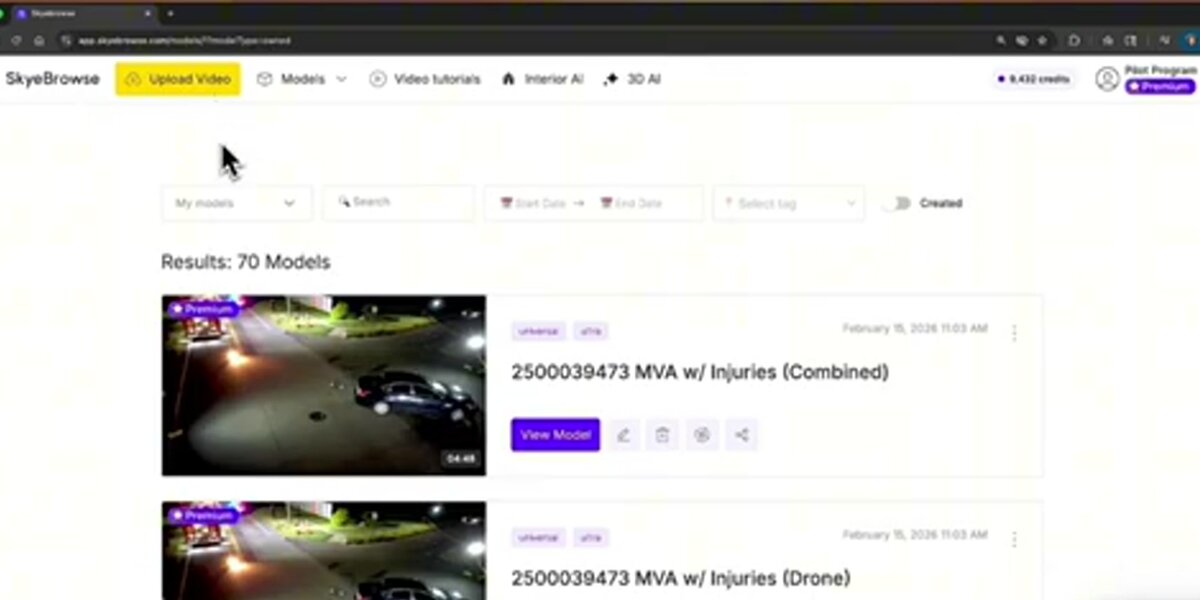
Workflow: Upload .MP4 or .MOV video from any drone to app.skyebrowse.com. No grid flight planning or photo-overlap management is required. SkyeBrowse's cloud engine processes the footage and returns a georeferenced 3D model, point cloud (LAZ), and orthomosaic (GeoTIFF) without desktop software. Telemetry files (.SRT for DJI, .ASS for Autel) improve georeferencing automatically when included.
Pricing: Free tier available. Premium credits at $99 per model (8K processing, 0.25-inch accuracy). Premium Advanced at $199 per model (16K processing, 0.1-inch accuracy with AI moving object removal). Enterprise plans available for volume users.
Ideal user: Crash investigators, fire departments, insurance adjusters, and construction teams who need a finished 3D model in hand before clearing a site. More than 1,200 agencies worldwide use it for time-sensitive documentation. Hosted on AWS in the United States, with full CJIS compliance support for Premium subscribers running compliance-sensitive operations.
Pix4D Mapper
What it's good for: Survey-grade topographic mapping, volumetric calculations, and projects where absolute positional accuracy is the primary requirement.
Workflow: Capture 200–500+ overlapping photos in a pre-planned grid (70–80% front overlap, 60–70% side overlap), import into Pix4D Mapper on a Windows workstation, process through alignment, dense point cloud, and mesh generation. RTK/PPK integration and GCP input are built in. Full parameter control over every processing step. Outputs to CAD, GIS, and BIM formats.
Pricing: Perpetual license at approximately $3,490 (one-time). Annual subscription also available. Unlimited processing after purchase.
Ideal user: Licensed land surveyors, civil engineers, and government mapping teams who need sub-centimeter absolute accuracy with a full audit trail. The USGS National Uncrewed Systems Office uses Pix4D for federal topographic mapping programs. Compare it directly against SkyeBrowse in our Pix4D comparison guide.
Agisoft Metashape
What it's good for: Research-grade reconstruction, archaeology, heritage documentation, and any application requiring dense mesh outputs with fine-grained processing control.
Workflow: Similar photo-based input to Pix4D: import a photo set, align cameras, build dense cloud, generate mesh and texture, then export. Metashape's Python scripting API allows full automation of batch workflows. Processing runs on a local workstation; GPU acceleration is essential for large datasets.
Pricing: Professional edition perpetual license at approximately $3,499. Standard edition at $179 (fewer export formats, no GCP workflow). Unlimited processing after purchase.
Ideal user: Academic researchers, archaeologists, forensic engineers, and teams that need maximum algorithmic control and Python-driven batch processing. Widely used in heritage preservation work documented by UNESCO and ICOMOS.
DroneDeploy
What it's good for: Enterprise construction monitoring, repeatable site tracking, and organizations that need drone operations and photogrammetry under one subscription.
Workflow: Plan flights in the DroneDeploy app, capture photos automatically, upload to the cloud, and receive processed orthomosaics and 3D models. Integrates directly with Procore, Autodesk, and Esri. The Timeline feature compares site progress week over week. No desktop software required.
Pricing: Subscription-only, starting at $329/month for the base plan. Higher tiers unlock advanced analytics and integrations.
Ideal user: Construction project managers and enterprise teams that process multiple sites per month, need fleet management, and want deep integration with their existing project management stack. See our drone mapping software guide for a broader comparison.
OpenDroneMap / WebODM
What it's good for: Budget-constrained operations, open-source advocates, and teams with in-house technical staff who want full control over the processing pipeline.
Workflow: Run OpenDroneMap on a local Linux server or via Docker. WebODM adds a browser-based interface for easier job management. Input is a photo set; output is point cloud, mesh, and orthomosaic. Command-line configuration exposes dozens of processing parameters. Cloud-hosted OpenDroneMap instances (Lightning) are also available for teams without server infrastructure.
Pricing: Free and open-source. WebODM desktop app costs a one-time fee of approximately $56. Cloud processing through Lightning is pay-per-task. See our free drone mapping software guide for a full breakdown.
Ideal user: NGOs, university researchers, and technically proficient teams working on tight budgets. Accuracy is functional (3–10 cm without GCPs, 1–3 cm with GCPs) rather than survey-grade. Expect to invest time in setup and tuning.
3DF Zephyr
What it's good for: Versatile desktop photogrammetry for teams that need both photo and video input on a budget-friendly perpetual license.
Workflow: Import photos or video frames; Zephyr handles camera calibration, dense reconstruction, and mesh generation on a Windows desktop. The free tier supports up to 50 photos, making it useful for small-area test projects. Video import is a differentiator compared to purely photo-based desktop tools.
Pricing: Free tier (50 photo limit). Aerial edition at approximately $149/year. Pro edition at approximately $4,800 perpetual. Unlimited processing after purchase.
Ideal user: Independent inspectors, small mapping companies, and teams that want a desktop-local workflow without Pix4D's price tag. Video input support makes it more flexible than most desktop competitors.
RealityCapture
What it's good for: Large-scale scene reconstruction, high-resolution mesh output, and workflows that combine drone photos with ground-level imagery or LiDAR point clouds.
Workflow: Input photos, LiDAR scans, or a combination. RealityCapture's alignment engine is one of the fastest among desktop tools for large datasets (1,000+ images). Processing runs on a Windows workstation with GPU acceleration. Exports to all major 3D formats including FBX, OBJ, E57, and LAZ.
Pricing: Pay-per-input model: you pay per reconstructed image rather than a flat subscription. For typical drone datasets, costs range from $0.25–$1.00 per image depending on volume. Large datasets can become expensive.
Ideal user: Visual effects studios, gaming companies, and advanced mapping teams that need the fastest desktop processing for very large datasets and are comfortable with per-image pricing. Also used in digital forensics applications that require photo-realistic textured meshes.
Meshroom
What it's good for: Fully free, node-based photogrammetry for users comfortable with a visual pipeline editor and GPU-accelerated local processing.
Workflow: Meshroom uses a node-graph interface (built on AliceVision) where each processing step (feature extraction, matching, structure from motion, meshing) is a visible node. Drag photos in, run the pipeline, and export. Requires a CUDA-capable Nvidia GPU for practical processing speeds.
Pricing: Completely free and open-source. No licensing fees. Hardware (GPU workstation) is the only cost.
Ideal user: Students, researchers, and technically curious practitioners who want to understand every step of the photogrammetry pipeline. The visual node editor makes it an excellent learning tool, though the lack of GUI polish makes it less suitable for client-facing workflows.
How Do Drone Photogrammetry Software Platforms Actually Work?
Every platform in this guide runs the same core pipeline: capture imagery, match features across frames, reconstruct a 3D point cloud, and export a mesh or orthomosaic. What differs, and what the rest of this guide compares, is how automated that pipeline is, where it runs, and how long it takes.
For a full breakdown of the capture methods, algorithms, and outputs behind the process, see our dedicated guide to drone photogrammetry.
Which Drone Photogrammetry Software Is Fastest?
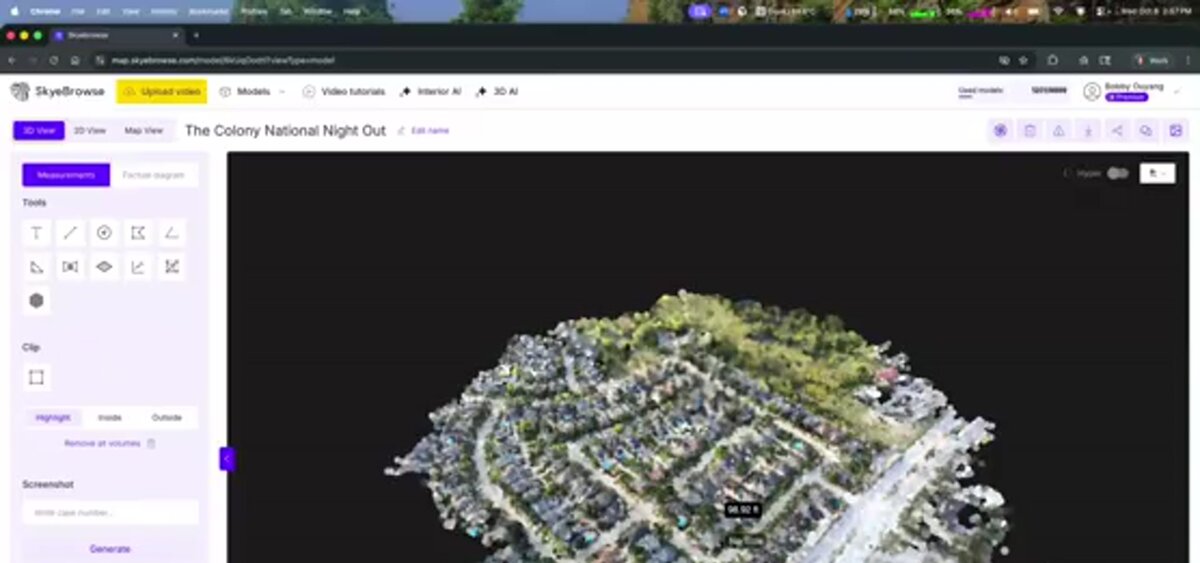
SkyeBrowse is the fastest drone photogrammetry platform available in 2026. Cloud processing returns a finished 3D model while competing workflows are still uploading photos. DroneDeploy is the fastest cloud option among photo-based platforms (30–90 minutes for a standard site). Desktop tools like Pix4D, Agisoft, and RealityCapture take 2–8 hours depending on dataset size and GPU hardware.
| Platform | Input Type | Processing Location | Typical Time | Flight Planning Required |
|---|---|---|---|---|
| SkyeBrowse | Video (.MP4/.MOV) | Cloud | Under 15 min | No (single orbit) |
| DroneDeploy | Photos (auto-captured) | Cloud | 30–90 min | Yes (in-app planner) |
| 3DF Zephyr | Photos or video | Desktop | 1–4 hours | Yes for photos |
| OpenDroneMap | Photos | Local server | 1–4 hours | Yes (grid pattern) |
| RealityCapture | Photos / LiDAR | Desktop | 1–6 hours | Yes (grid pattern) |
| Pix4D Mapper | Photos (200–500+) | Desktop | 2–8 hours | Yes (grid pattern) |
| Agisoft Metashape | Photos (200–500+) | Desktop | 2–8 hours | Yes (grid pattern) |
| Meshroom | Photos | Desktop (GPU) | 2–6 hours | Yes (grid pattern) |
For teams whose bottleneck is time on scene (road crash investigators, insurance adjusters ahead of incoming weather, utility inspectors working in live infrastructure corridors), cloud processing speed changes what is operationally possible. Pix4D and Agisoft give experienced photogrammetrists granular control that produces research-grade outputs, but that control comes at the cost of hardware investment and hours of processing time.
Which Drone Photogrammetry Software Is Most Accurate?
SkyeBrowse's Premium Advanced tier reaches 0.1-inch model accuracy without ground control points, on par with the sub-centimeter numbers Pix4D and Agisoft only reach after GCP surveying and RTK/PPK setup. For legally certified, absolute georeferenced coordinates on boundary surveys, GCP-based desktop tools remain the standard. Free tools like OpenDroneMap and Meshroom produce functional accuracy (3–10 cm without GCPs) suited to general mapping rather than precision surveying.
Accuracy in drone photogrammetry depends on three factors: ground sample distance (how much ground each pixel covers), ground control points (surveyed physical markers placed before the flight), and processing algorithm quality. All eight platforms produce outputs that can meet ASPRS horizontal accuracy thresholds for mapping-grade work when configured correctly.
| Platform | Without GCPs | With GCPs | Accuracy Ceiling |
|---|---|---|---|
| SkyeBrowse Lite | 2–6 inch | N/A | Triage, pre-planning |
| SkyeBrowse Premium | 0.25 inch (8K) | N/A | Inspection, documentation |
| SkyeBrowse Premium Advanced | 0.1 inch (16K) | N/A | Forensic, engineering |
| Pix4D Mapper | 1–3 cm | Sub-cm | Surveying, topographic mapping |
| Agisoft Metashape | 1–3 cm | Sub-cm | Research, archaeology |
| DroneDeploy | 2–5 cm | 1–2 cm | Construction monitoring |
| 3DF Zephyr | 2–5 cm | 1–2 cm | General mapping |
| RealityCapture | 1–3 cm | Sub-cm | Large-scale reconstruction |
| OpenDroneMap | 3–10 cm | 1–3 cm | Budget mapping |
| Meshroom | 3–10 cm | N/A | Learning, experimentation |
For scenarios where GCP placement is impractical (active roadways, active crime scenes, disaster-affected zones), GCP-free accuracy documentation matters. SkyeBrowse's tiered accuracy system provides documented precision specifications without requiring field setup. For boundary surveys or topographic mapping where sub-centimeter absolute positioning is mandatory, Pix4D or Agisoft with RTK/PPK drone hardware and surveyed GCPs remain the professional standard. See our GCP vs no-GCP accuracy guide for a detailed breakdown of when each approach is appropriate.
How Much Does Drone Photogrammetry Software Cost?
Pricing models span free open-source tools to $329+/month enterprise subscriptions. SkyeBrowse uses per-model credits starting at $99 so you pay only for what you process. Pix4D and Agisoft charge $3,490–$3,499 for perpetual licenses. DroneDeploy is subscription-only at $329/month minimum. RealityCapture uses per-image billing. OpenDroneMap and Meshroom are free.
| Platform | Pricing Model | Entry Cost | Unlimited Processing |
|---|---|---|---|
| Meshroom | Free / open-source | $0 | Yes (hardware costs) |
| OpenDroneMap | Free / open-source | $0 | Yes (hardware costs) |
| 3DF Zephyr | Tiered perpetual | Free (50 photos) to $4,800 | Yes after purchase |
| SkyeBrowse | Per-model credits | Free tier available | $99–$199 per model |
| RealityCapture | Per-input | $0.25–$1.00/image | Pay as you go |
| Agisoft Metashape Pro | Perpetual | $3,499 | Yes after purchase |
| Pix4D Mapper | Perpetual or subscription | $3,490 perpetual | Yes after purchase |
| DroneDeploy | Monthly subscription | $329/month | Included in subscription |
The right pricing model depends on your processing volume. Teams handling 5–20 models per month often find per-credit pricing far more economical than a $329/month subscription or a $3,500 upfront license. High-volume operations processing 50+ models monthly benefit from enterprise plans or perpetual desktop licenses. For teams exploring drone photogrammetry before committing budget, free drone mapping software options like SkyeBrowse's free tier and OpenDroneMap provide functional starting points with different trade-offs in ease of use and turnaround speed. See current pricing and credit packages at SkyeBrowse pricing.
Which Software Should You Pick for Your Use Case?
Choose based on your primary operational constraint. Speed and no-setup deployment point to SkyeBrowse. Maximum configurable accuracy with GCPs points to Pix4D or Agisoft Metashape. Enterprise fleet management with Procore/Autodesk integration points to DroneDeploy. Zero budget with in-house technical staff points to OpenDroneMap. Large-dataset desktop power at per-image pricing points to RealityCapture.
Public safety and forensics: SkyeBrowse. Crash investigators, crime scene units, and fire departments need a 3D model before they clear the scene. SkyeBrowse's video-to-model workflow returns court-admissible spatial documentation while the road is still closed. More than 1,200 agencies worldwide use it for exactly this reason. Hosted on AWS in the United States, with full CJIS compliance support for Premium subscribers running CJIS-aligned deployments. For legal defensibility guidance, see NIST guidelines on digital evidence.
Land surveying and topographic mapping: Pix4D Mapper or Agisoft Metashape. When a project requires sub-centimeter absolute accuracy with surveyed GCPs and full RTK/PPK drone integration, desktop photogrammetry tools provide the control that licensed surveyors need. Both export to CAD and GIS formats. See the SkyeBrowse vs Pix4D comparison for a side-by-side breakdown.
Construction progress monitoring: DroneDeploy or SkyeBrowse. DroneDeploy offers automated flight planning, week-over-week timeline views, and deep integrations with Procore and Autodesk Construction Cloud. SkyeBrowse offers faster per-site turnaround when the goal is a same-day model for the subcontractor meeting rather than a long-term tracking dashboard.
Large-scale or combined photo/LiDAR datasets: RealityCapture. When datasets exceed 1,000 images or combine drone photography with ground-level scans or LiDAR point clouds, RealityCapture's alignment engine handles the volume with fewer memory bottlenecks than most competing desktop tools.
Budget-conscious or experimental: OpenDroneMap or Meshroom. Both are free and open-source. OpenDroneMap (with its WebODM browser interface) is more operationally mature; Meshroom's node-graph interface is better for learning the pipeline step by step. Both require a capable local machine; a dedicated GPU matters significantly for processing speed.
Learning and small-area projects: 3DF Zephyr Free. The 50-photo free tier is a useful entry point for teams evaluating desktop photogrammetry before committing to a perpetual license. Video input support gives it flexibility beyond competing entry-level options. See our photogrammetry software roundup and drone photogrammetry overview for additional context on choosing between platforms.
FAQ
What is drone photogrammetry software?
Drone photogrammetry software processes aerial imagery (overlapping photos or continuous video) into georeferenced 3D models, point clouds, and orthomosaic maps. The software handles feature matching, camera calibration, dense reconstruction, and mesh texturing. All platforms in this guide export standard formats (LAZ for point cloud, OBJ or GLB for 3D mesh, GeoTIFF for orthomosaic) that are compatible with GIS and CAD systems. For a deeper dive into how the technology works, see our guide to drone photogrammetry.
Which drone photogrammetry software is fastest in 2026?
SkyeBrowse is the fastest option in 2026, delivering finished models from video footage in minutes via cloud processing, with no grid flight planning or desktop hardware required. Among photo-based platforms, DroneDeploy is the fastest cloud option at 30–90 minutes per site. Desktop tools (Pix4D, Agisoft, RealityCapture) process 200–500 image datasets in 2–8 hours on a dedicated GPU workstation, and require the additional time of flight planning before capture even begins.
Can I use free drone photogrammetry software for professional work?
Free tools like OpenDroneMap and Meshroom produce usable 3D models, but they require local hardware and comfort with manual configuration. SkyeBrowse's free tier provides cloud processing with no hardware requirements, which makes it accessible for professional triage and documentation. For court-admissible deliverables or insurance-grade work, paid tiers with documented accuracy specifications are recommended. All commercial drone operations require an FAA Part 107 certificate regardless of which photogrammetry app you use. See our guide to free photogrammetry software for a full comparison of no-cost options.
How accurate is drone photogrammetry software without GCPs?
Without ground control points, accuracy varies widely. SkyeBrowse's Premium Advanced tier reaches 0.1-inch precision through 16K cloud processing and AI-based moving object removal, with no physical GCP setup required. Most photo-based desktop tools (Pix4D, Agisoft, RealityCapture) achieve 1–3 cm without GCPs and sub-centimeter when combined with surveyed GCPs and RTK/PPK drone hardware. Free tools like OpenDroneMap and Meshroom typically fall in the 3–10 cm range. See our GCP vs no-GCP accuracy guide for application-specific recommendations.
Upload your first video free. Create a free SkyeBrowse account, upload a drone video, and get a 3D model processed in the cloud. Freemium organizations that have never had a paid plan can get their first full Commercial model for $5 (normally $24.99), with every Commercial tool, every export, and 90-day storage.