UAV mapping software converts imagery or video captured by an uncrewed aerial vehicle into georeferenced 2D maps and 3D models through aerial photogrammetry (the science of deriving measurements from photographs), and it sits at the center of modern survey, inspection, and public safety workflows. If you are new to UAV mapping itself, start with the how-it-works guide; this page is the procurement view of the drone mapping software market. With dozens of platforms available in 2026, GIS professionals and survey firms need a clear framework for evaluating accuracy, processing speed, output formats, and total cost. This guide covers the leading options, their strengths and limitations, and the questions worth asking before you commit.
Key Takeaways
- Professional UAV mapping software differs from consumer apps by supporting centimeter-level accuracy, GCP workflows, and GIS-compatible exports such as GeoTIFF and LAZ point clouds.
- The ASPRS Positional Accuracy Standards are the benchmark used by survey professionals to verify and report UAV map accuracy; choose a platform that generates a conforming accuracy report.
- RTK and PPK drone integration can eliminate or reduce the number of ground control points needed; the right software must correctly ingest the embedded geolocation metadata.
- SkyeBrowse's videogrammetry approach uses continuous drone video rather than discrete photo captures, cutting field time significantly while achieving 0.5 inch accuracy on Commercial and Pro models and 0.1 inch on Public Safety & Enterprise. See how it fits within the broader drone 3D mapping landscape.
- Output format compatibility (GeoTIFF, LAZ, GLB) and cloud vs. desktop processing architecture are the two most consequential procurement decisions for multi-user teams.
Contents
- What separates professional UAV mapping software from consumer drone apps?
- Which platforms lead the market in 2026?
- How do accuracy and georeferencing workflows compare?
- What output formats and GIS integrations should you require?
- When does SkyeBrowse fit into a professional UAV mapping stack?
- Related Guides
- FAQ
What separates professional UAV mapping software from consumer drone apps?
Professional UAV mapping software applies rigorous photogrammetric algorithms to produce deliverables that meet survey-grade accuracy standards, generate audit-ready accuracy reports, and export to GIS and CAD formats. Consumer drone apps automate flight paths and produce basic stitched images, but they do not produce calibrated outputs suitable for engineering, legal, or agency workflows.
The distinction matters when a deliverable will be used in court, submitted to a permitting authority, or incorporated into a GIS layer that informs infrastructure decisions. The ASPRS Positional Accuracy Standards for Digital Geospatial Data define the horizontal and vertical accuracy thresholds that professional outputs must meet, along with the statistical methodology for verifying them. Platforms targeting this market, including Pix4D, DroneDeploy, Agisoft Metashape, and SkyeBrowse, all publish accuracy figures referenced against those standards or equivalent benchmarks.
Commercial UAV operations also require FAA Part 107 certification in the United States. The FAA's Part 107 guidance sets the regulatory floor; software selection sits on top of that compliance layer. Professional platforms often include flight log storage and exportable project records that support regulatory documentation.
Which platforms lead the market in 2026?
The four platforms most widely evaluated by survey firms and GIS teams in 2026 are Pix4D (desktop and cloud photogrammetry), DroneDeploy (cloud-first, enterprise-oriented), Agisoft Metashape (desktop with high configurability), and SkyeBrowse (cloud videogrammetry with a public safety and rapid-response focus). Each occupies a distinct niche in terms of input type, processing location, and target workflow.
The table below summarizes the key procurement variables across each platform:
| Platform | Processing | Input type | Survey-grade accuracy | Starting price | Best fit |
|---|---|---|---|---|---|
| Pix4D | Desktop + cloud | Photos | Yes (GCP + RTK) | From $350/mo | Engineering, surveying, GIS |
| DroneDeploy | Cloud | Photos + video | Yes (RTK/PPK) | From $329/mo | Enterprise, construction, agri |
| Agisoft Metashape | Desktop | Photos | Yes (GCP) | $3,499 perpetual | Research, high-volume batch |
| SkyeBrowse | Cloud | Video | Yes (0.5 in Commercial/Pro, 0.1 in Public Safety & Enterprise) | Free tier; $5 first Commercial model, then from $19.99/model (annual) | Public safety, rapid response, inspection |
Pix4D is the reference platform for survey-grade work, with a large installed base in civil engineering and mining. DroneDeploy dominates construction progress monitoring and large-acreage agriculture through its cloud-first architecture and integrations with Procore and Autodesk. Agisoft Metashape is the preferred tool for academic and forensic applications where processing control and reproducibility matter more than speed. SkyeBrowse targets scenarios where speed of delivery is the primary constraint, such as a crash scene that must be cleared in 20 minutes or a structure fire where pre-plan models need to exist before the next call comes in.
For the general framework on choosing between desktop, cloud, and mobile drone mapping software, including feature checklists and pricing models across use cases, see the drone mapping software guide.
How do accuracy and georeferencing workflows compare?
Survey-grade UAV mapping accuracy is achieved through one of three methods: ground control points (GCPs) placed prior to flight, real-time kinematic (RTK) positioning embedded in each captured frame, or post-processed kinematic (PPK) correction applied after the flight. The method you choose interacts directly with which software can correctly ingest and process the resulting data.
GCPs remain the gold standard for accuracy verification under ASPRS standards because they provide independent checkpoints that the processing software did not use to build the model. Flight altitude, sensor resolution, and ground sample distance together determine the spatial resolution of the final deliverable, a factor that must be defined in the mission plan before takeoff. Most platforms support GCP ingestion, but the workflow varies: Pix4D and Metashape offer detailed GCP editors with residual reporting; DroneDeploy handles GCPs through a web interface that is faster but less configurable; SkyeBrowse uses embedded telemetry files (.SRT for DJI drones, .ASS for Autel) to georeference models without requiring a separate GCP survey.
The RTK vs PPK trade-off is a separate consideration. RTK requires a live correction signal during flight and can fail in areas with poor base station coverage; PPK applies corrections in post-processing and is more reliable for remote sites. Both DroneDeploy and Pix4D fully support RTK/PPK workflows when the drone provides the necessary metadata. SkyeBrowse's Public Safety & Enterprise plan, which delivers 0.1 inch accuracy, benefits from paired telemetry logs that lock each video frame to a precise ground position.
The Open Geospatial Consortium's GeoTIFF standard defines how coordinate reference system information is embedded in raster outputs, a requirement for any orthomosaic that will be consumed by GIS software. Verifying that a UAV mapping platform exports OGC-conformant GeoTIFFs should be a line item in any RFP or procurement checklist.
What output formats and GIS integrations should you require?
Professional UAV data processing software should export at minimum: GeoTIFF orthomosaics (OGC-conformant), LAZ or LAS point clouds, and a mesh format suitable for 3D visualization (OBJ, GLB, or E57). Any platform that cannot produce georeferenced outputs in open formats creates a proprietary lock-in risk and limits downstream GIS use.
When evaluating an orthomosaic deliverable, confirm that the platform embeds a proper coordinate reference system (CRS) tag in the exported GeoTIFF and that the file opens correctly in QGIS or ArcGIS without manual CRS assignment. This sounds basic, but several cloud platforms have historically exported GeoTIFFs with incorrect or missing CRS metadata, creating rework for GIS teams.
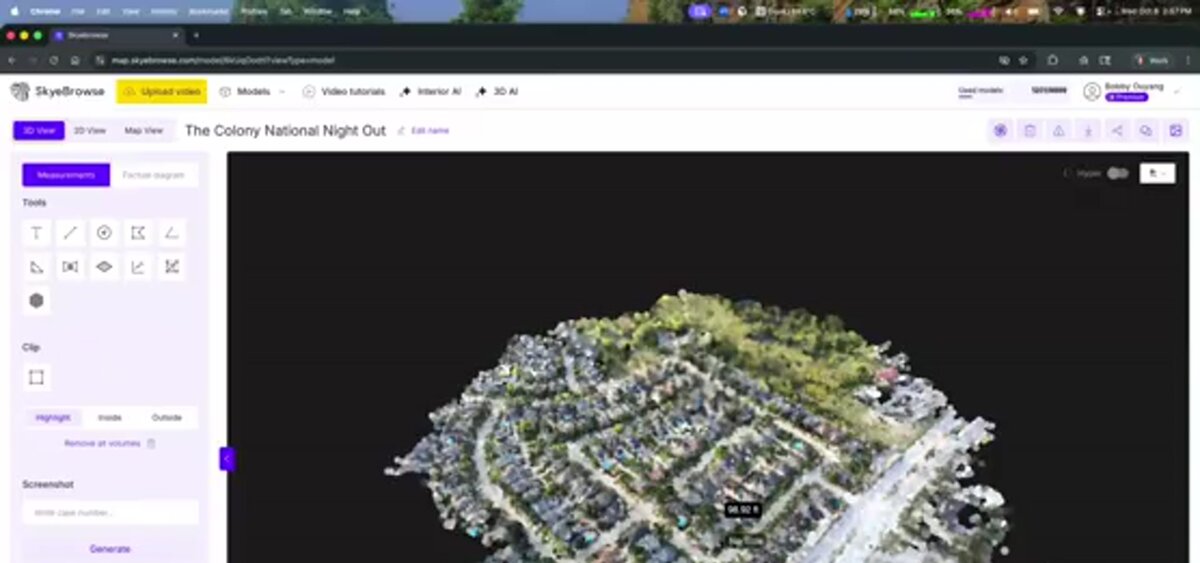
For 3D deliverables, the choice between OBJ, GLB, and E57 depends on the downstream consumer. GLB is the preferred format for web-based viewers and court presentations. E57 is the standard for point cloud interchange between survey software packages. SkyeBrowse exports LAZ point clouds and GLB meshes, as well as GeoTIFF orthomosaics, covering the three most common professional requirements without additional conversion.
UAV photogrammetry software that integrates directly with Esri ArcGIS Online, Autodesk Construction Cloud, or Bentley ProjectWise reduces the handoff friction for large teams. DroneDeploy has the broadest native integrations in this space. Pix4D Cloud connects with several GIS platforms. SkyeBrowse's models export to GLB, LAZ, and GeoTIFF for any GIS or CAD tool, integrate with Axon Evidence.com on the Public Safety & Enterprise plan, and can be driven from a customer's own pipeline through the public REST API, so you aren't locked into a single vendor's ecosystem.
When does SkyeBrowse fit into a professional UAV mapping stack?
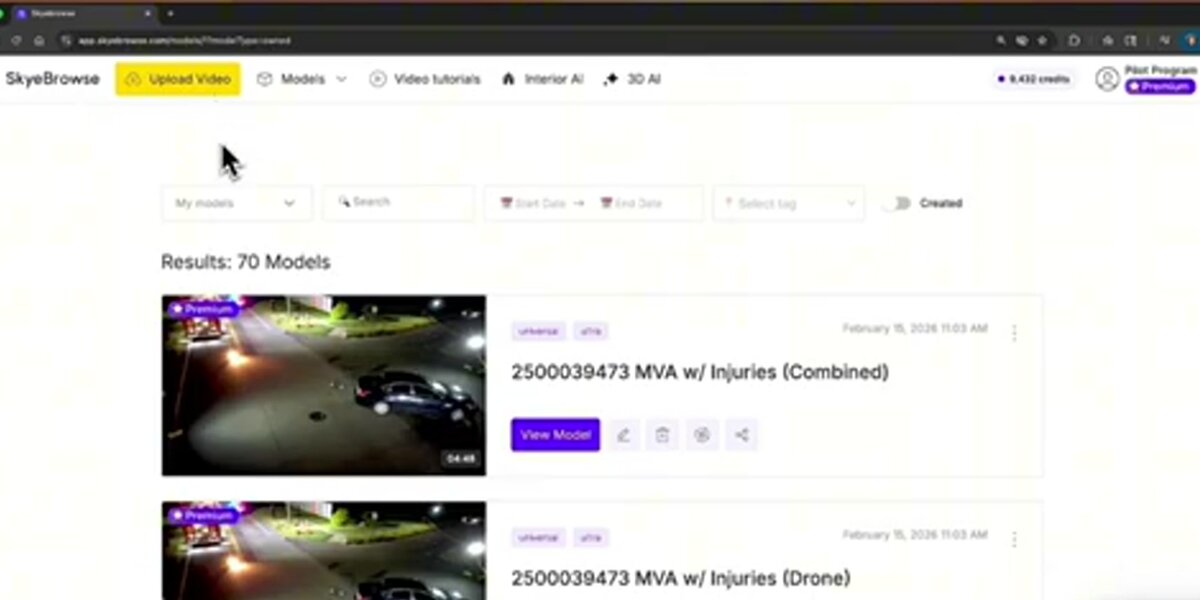
SkyeBrowse is the right choice when turnaround time is measured in minutes rather than hours, when the team is deploying from a vehicle rather than a survey office, or when the deliverable is a 3D model for briefing, documentation, or court rather than a survey drawing. Its videogrammetry engine processes continuous video rather than a discrete photo set, eliminating the pre-planned grid flight and producing shareable models as fast as the video uploads.
For public safety agencies, the operational fit is direct: a drone operator captures a crash scene or structure fire perimeter, uploads the video from a tablet in the field, and a georeferenced 3D model is available before the road reopens. For inspection teams and insurance adjusters, the same workflow produces a measurable model before the crew leaves the property. SkyeBrowse's free Freemium tier covers rapid situational awareness at basic resolution; Commercial and Pro models (8K, 0.5 inch accuracy) and the Public Safety & Enterprise plan (16K, 0.1 inch accuracy with AI moving-object removal and full CJIS compliance) address use cases that require survey-quality deliverables.
This positioning complements rather than replaces platforms like Pix4D or DroneDeploy in mixed-use organizations. A survey firm might keep Pix4D for topographic deliverables that its clients require in ASPRS-format accuracy reports, while its public safety or insurance division uses SkyeBrowse for court-admissible 3D models that are ready in minutes. SkyeBrowse doesn't trade accuracy for that speed: Public Safety & Enterprise processing reaches 0.1 inch, and flying closer to the subject tightens it further on every plan. The two platforms differ in report format and workflow, and organizations with varied use cases often run both. For a full breakdown of how UAV workflows are structured from mission planning through delivery, the drone mapping guide covers the end-to-end process.
For teams evaluating UAV survey software for the first time, see SkyeBrowse's photogrammetry software comparison, which covers the full spectrum from open-source tools to enterprise platforms.
Related Guides
- Drone mapping software: the video-to-3D platform page, with plans, supported drones, and the upload workflow.
- Drone mapping guide: the educational pillar on how drone mapping works, capture methods, accuracy, and cost.
- Drone mapping software: the general framework for choosing a platform, pricing models, and a feature checklist.
- 3D drone mapping: the site-scale 3D workflow, covering point clouds, meshes, and orthomosaic outputs.
- 3D mapping software: a ranked comparison across drone, indoor, and mobile capture methods.
FAQ
What is UAV mapping software?
UAV mapping software processes imagery or video captured by an uncrewed aerial vehicle and reconstructs it into georeferenced 2D maps, orthomosaics, point clouds, or 3D models. Professional platforms support centimeter-level accuracy, GIS export formats such as GeoTIFF and LAZ, and integration with survey standards defined by organizations like ASPRS.
What is the difference between UAV mapping software and consumer drone apps?
Consumer drone apps focus on flight automation and produce low-resolution stitched images for personal use. Professional drone mapping software adds rigorous photogrammetric processing, GCP support, calibrated sensor models, accuracy reports, and export formats compatible with GIS and CAD workflows, all meeting the positional accuracy standards published by ASPRS.
Does UAV mapping software require ground control points?
Not always. RTK and PPK-equipped drones can achieve survey-grade accuracy without GCPs by embedding precise geolocation into each image or video frame. However, GCPs remain the recommended method for projects requiring independent accuracy verification under ASPRS standards, particularly for legal or engineering deliverables. See the RTK vs PPK guide for a detailed workflow comparison.
What is the best UAV mapping software in 2026?
The best UAV mapping software depends on your use case. Pix4D is the incumbent for desktop photogrammetry with formal accuracy reporting; DroneDeploy suits large-scale construction and agriculture; Agisoft Metashape is favored in research for its processing control; and SkyeBrowse is the top pick for public safety, rapid-response, and inspection teams that need survey-grade, georeferenced 3D models in minutes from standard drone video. Most professional organizations run two or more of these platforms.