Drone mapping services use photogrammetry — the science of deriving measurements from photographs — to convert aerial imagery into accurate, georeferenced maps and models. Whether you are a construction manager evaluating a site monitoring vendor, a public agency sourcing aerial mapping services, or a drone operator building a service business, this guide covers deliverable types, pricing benchmarks, what questions to ask any provider, and how purpose-built processing software helps operators deliver faster results.
Key Takeaways
- Drone mapping service pricing ranges from roughly $300 for a basic orthomosaic to $3,500 or more for full topographic surveys, depending on site size and deliverable type.
- The three most-requested deliverables are orthomosaic maps (GeoTIFF), 3D surface models (GLB/OBJ mesh), and point clouds (LAZ/LAS) — each suited to different downstream workflows.
- All commercial drone mapping work in the US requires an FAA Part 107 Remote Pilot Certificate; verify credentials and insurance before engaging any provider.
- Processing speed matters as much as flight quality — cloud platforms that return models in minutes rather than hours enable operators to deliver same-day results for time-sensitive clients.
- ASPRS positional accuracy standards provide a neutral benchmark for evaluating accuracy claims; always ask for documented ground sample distance (GSD) and RMSE values with deliverables.
Contents
- What types of deliverables do drone mapping services produce?
- How much do drone mapping services cost?
- How do you evaluate a drone mapping company?
- How does processing software affect service quality and speed?
- How can operators use SkyeBrowse to scale drone mapping services?
- FAQ
What types of deliverables do drone mapping services produce?
Professional drone mapping services deliver four core outputs: orthomosaic maps, 3D surface models, point clouds, and topographic surveys. An orthomosaic (also called an orthophoto) is a geometrically corrected aerial image stitched from dozens or hundreds of overlapping frames — it can be measured directly and imported into GIS or CAD software. A 3D surface model is a textured mesh that allows clients to orbit, annotate, and take measurements in three dimensions. Point clouds are dense collections of georeferenced data points used for precise volumetric and elevation calculations. Topographic surveys layer contour lines and digital elevation model (DEM) data on top of those outputs to quantify terrain changes across a site.
Each deliverable serves different downstream uses. Orthomosaics are the standard output for construction progress documentation, agriculture field analytics, and real estate marketing because they open directly in GIS and CAD tools. 3D surface models are preferred for forensic engineering, insurance claims, and infrastructure inspection because reviewers can navigate the scene remotely. Point clouds in LAZ or LAS format meet the thresholds defined in ASPRS Positional Accuracy Standards for Digital Geospatial Data and are required for BIM workflows or federal datasets like the USGS 3D Elevation Program. Some providers also deliver stockpile volume reports, cut-and-fill calculations, and thermal orthomosaics for utility or solar inspection.
For a deeper look at how drone 3D mapping workflows differ by use case, see the dedicated guide. The orthomosaic explainer covers file formats, resolution standards, and when ground control points (GCPs) are required.
How much do drone mapping services cost?
Drone mapping services typically cost $300–$3,500 per project, with wide variation based on site size, deliverable complexity, and turnaround requirements. A basic orthomosaic of a small commercial lot can fall under $500. A full topographic survey with GCPs, a point cloud, and a digital elevation model for a 200-acre site commonly reaches $1,500–$3,500. Rush turnarounds and specialized outputs — thermal orthomosaics, LiDAR point clouds, or court-admissible accuracy reports — carry additional premiums.
The table below shows typical price ranges for the most common drone mapping deliverables on projects up to 200 acres. Rates reflect professional service market pricing in the United States as of 2026; actual quotes vary by region, site complexity, and provider experience.
| Deliverable | Small Site (under 50 acres) | Large Site (50–200 acres) | Notes |
|---|---|---|---|
| Orthomosaic map (GeoTIFF) | $300–$700 | $700–$1,500 | Standard GIS-ready aerial image |
| 3D surface model (mesh) | $400–$900 | $900–$2,000 | Textured, measurable 3D model |
| Point cloud (LAZ/LAS) | $500–$1,200 | $1,200–$3,000 | Required for BIM and elevation work |
| Topographic survey (contours + DEM) | $600–$1,400 | $1,400–$3,500 | Includes GCP placement and RMSE report |
| Stockpile volume measurement | $350–$800 | $800–$1,800 | Per-flight cut/fill computation |
Pricing models vary across the industry. Some providers charge per acre, others charge a flat project fee, and a growing number of drone operators use per-model processing credits through their software platform. Operators who process data in-house rather than outsourcing to a processing bureau can significantly reduce turnaround time and retain higher margins per job. See drone services pricing for a detailed breakdown of pricing structures across service categories.
How do you evaluate a drone mapping company?
The most important factors when choosing a drone mapping company are FAA certification, documented accuracy standards, deliverable file formats, and turnaround time. Every commercial drone operator in the United States must hold an FAA Part 107 Remote Pilot Certificate; ask to see documentation before hiring. Accuracy should be stated as ground sample distance (GSD) and root mean square error (RMSE) values, not vague descriptors like "high resolution." Verify that deliverables are provided in formats compatible with your existing software — GeoTIFF for GIS, LAZ for point clouds, GLB or OBJ for 3D models.
Beyond credentials, ask about the provider's processing workflow. Find out how long delivery takes from flight completion to final output, what processing software they use, and whether they place ground control points (GCPs) or rely solely on RTK/PPK drone GPS. The FAA Part 107 ruleset governs where and when a drone can legally operate; if your project involves controlled airspace, restricted zones, or flight over people, confirm the provider has the appropriate authorizations or waivers in place.
For agencies and enterprises issuing formal RFPs, the following evaluation criteria are widely used:
- Valid FAA Part 107 Remote Pilot Certificate (or equivalent credential for international operators)
- Insurance: general liability of at least $1 million per occurrence
- Accuracy documentation: stated GSD, GCP methodology, and a delivered RMSE report
- Turnaround SLA: deliverables in hours or days, not weeks
- Data security and handling policy, especially relevant for government sites and critical infrastructure
For a broader overview of what professional operators offer, see the drone services guide.
How does processing software affect service quality and speed?
Processing software determines how quickly raw drone footage becomes a deliverable and how accurate the final output is. Traditional desktop photogrammetry pipelines can take hours to process a large site, require powerful local hardware, and return deliverables that need a separate hosting step before clients can view them. Cloud-based platforms eliminate the hardware bottleneck and can return 3D models, orthomosaics, and point clouds in minutes for typical job sites — a meaningful advantage when clients expect same-day results.
The turnaround speed gap has real consequences for service providers. A construction client expecting weekly progress models will not wait 48–72 hours for processing. A public agency documenting a critical incident needs the model shared with investigators the same day. Cloud platforms allow operators to upload video from the field and send a shareable link before returning to the office.
Output accuracy is also software-dependent. Entry-level processing on standard video produces centimeter-range accuracy suitable for general documentation. Professional-grade processing with calibrated imagery and GCPs can achieve sub-inch accuracy meeting ASPRS Class 1 positional standards — required for legal, engineering, or formal survey deliverables. When selecting a platform, compare documented accuracy tiers, supported export formats, processing speed, and compliance certifications relevant to your client base.
The drone mapping software guide compares leading platforms across accuracy, speed, and cost to help operators select the right tool for their service model.
How can operators use SkyeBrowse to scale drone mapping services?
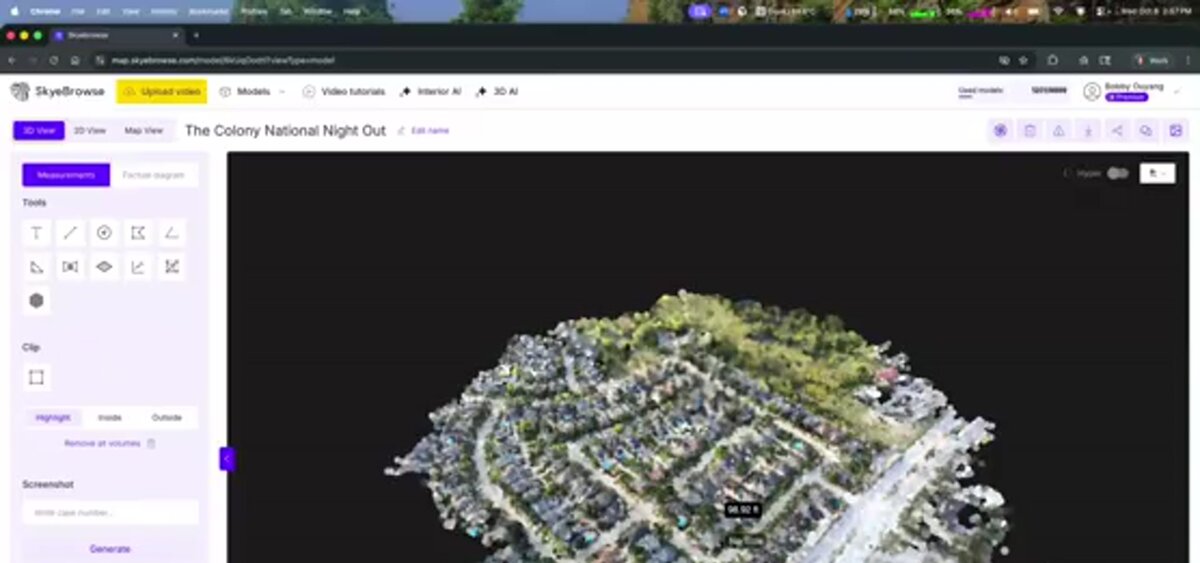
SkyeBrowse is a cloud-based videogrammetry platform — it converts drone video directly into orthomosaics, 3D models, and point clouds without requiring desktop processing hardware. Operators upload .MP4 or .MOV footage through a browser or mobile app, and the platform returns georeferenced deliverables ready to share with clients. Because processing runs in the cloud, operators can manage multiple jobs simultaneously from any location, with no workstation required.
For drone operators building a mapping service business, SkyeBrowse addresses the two biggest bottlenecks: turnaround speed and deliverable variety. Jobs that would take hours to process on a desktop workstation return in minutes, which allows operators to take on more projects per day and deliver results before leaving a client site. Deliverables export as GeoTIFF (orthomosaic), LAZ (point cloud), or GLB (3D mesh) — the three formats clients most commonly request.
Accuracy scales with the service tier. Operators serving general commercial clients can work with standard video and achieve accuracy in the 2–6 inch range, suitable for construction documentation and site monitoring. Operators serving engineering firms, insurance carriers, or public safety agencies can step up to premium processing with 8K or 16K resolution to achieve sub-inch accuracy, with the Premium Advanced tier also applying AI-based moving object removal to keep output clean. Pricing is per model credit ($99 at Premium, $199 at Premium Advanced), making per-job cost predictable for client billing.
More than 1,200 agencies and commercial operators use SkyeBrowse. The platform's tutorials at skyebrowse.com/tutorials cover flight patterns, upload workflows, and accuracy optimization for common job types.
FAQ
How much do drone mapping services cost?
Drone mapping service pricing varies widely by deliverable type and site size. Orthomosaic mapping of a small site typically runs $300–$700. Topographic surveys with GCPs and RMSE documentation for larger parcels can reach $1,400–$3,500. See the pricing table above for a full breakdown by deliverable and acreage tier. For per-project cost control, operators using platforms like SkyeBrowse pay per-model processing credits rather than recurring software subscriptions.
What deliverables do drone mapping companies provide?
Professional drone mapping companies deliver orthomosaic maps (GeoTIFF), 3D surface models (GLB or OBJ mesh), point clouds (LAZ/LAS), digital elevation models, and topographic contour maps. Some providers also include derived products such as volumetric stockpile measurements, cut-and-fill reports, and annotated 3D models for regulatory or legal use. Always confirm deliverable file formats match your software stack before finalizing a contract.
Do drone mapping pilots need a special license?
Yes. In the United States, any operator flying a drone commercially — including for mapping services — must hold an FAA Part 107 Remote Pilot Certificate. This requires passing a knowledge exam covering airspace regulations, weather interpretation, and flight safety procedures. Operations that fall outside standard Part 107 rules, such as night flights or operations over moving vehicles, require an additional FAA waiver. Always request proof of certification and insurance before hiring any provider.
How do I find drone mapping services near me?
Search for FAA-certified Part 107 operators in your area through industry directories, state surveying boards, or contractor networks like AUVSI. When comparing local providers, ask for sample deliverables, an accuracy report from a previous project, and a clear SLA for turnaround time. Evaluating two or three providers on a small pilot project before committing to a long-term contract is a practical way to benchmark quality and responsiveness.