Hazmat incident documentation has traditionally forced entry teams into chemical hazard zones just to photograph conditions, measure spill extents, and gather evidence. Videogrammetry — the process of converting drone video into georeferenced 3D models — changes that calculus entirely. SkyeBrowse processes drone footage captured from standoff positions outside the hot zone and returns a complete, measurable incident site model in minutes, giving commanders the spatial data they need before a single entry team member suits up.
Key Takeaways
- Drone reconnaissance flown from upwind standoff positions eliminates entry team exposure for initial hazmat documentation.
- A 10-minute hazmat flight returns a complete georeferenced 3D model in approximately 10 minutes — fast enough to drive real-time containment decisions.
- SkyeBrowse Premium delivers approximately 0.25-inch accuracy for spill extent measurements; Premium Advanced reaches 0.1-inch for regulatory volume documentation.
- LAZ point cloud exports from SkyeBrowse integrate directly with ALOHA and CAMEO plume modeling tools, using actual terrain geometry for more accurate vapor dispersion estimates.
- AWS GovCloud hosting with five-year model retention and full audit trails supports EPA enforcement timelines and civil litigation requirements.
Contents
- Why does traditional hazmat documentation put responders at unnecessary risk?
- How does standoff drone reconnaissance work at a hazmat scene?
- How accurate is drone-based spill quantification for EPA reporting?
- What does secure hazmat scene data look like for regulatory and legal purposes?
- How does hazmat drone mapping fit into pre-incident planning?
- FAQ
Why does traditional hazmat documentation put responders at unnecessary risk?
Traditional hazmat documentation requires entry teams wearing Level A or B protective equipment to enter hot zones, photograph conditions, and manually measure spill extents. That exposure consumes limited air supply, raises injury risk, and often delays the spatial intelligence commanders need for early containment decisions.
OSHA's HAZWOPER standard (29 CFR 1910.120) defines hot zone entry procedures for a reason: hazardous atmospheres impose immediate physiological risks on anyone inside them. When unknown concentrations or reactive chemistries are present, even properly equipped entry teams face residual exposure risk. The documentation task — measuring how far a spill has migrated, identifying which containers are breached, assessing drainage pathways — doesn't require human presence in the hot zone if aerial alternatives exist.
A four-person entry team documenting a hazmat scene typically consumes two to four hours, several sets of PPE, and significant decontamination resources. Ground-level photographs and hand-measured distances rarely provide the overhead perspective commanders need to understand spill migration patterns and set containment priorities.
Aerial documentation doesn't replace entry teams — it ensures they enter with a complete tactical picture and focused objectives, reducing exposure time in hazardous conditions.
How does standoff drone reconnaissance work at a hazmat scene?
A drone operator launches from an upwind position outside the hot zone perimeter, flies reconnaissance patterns over the incident site, then lands and uploads the video footage remotely. SkyeBrowse processes the footage and returns a georeferenced 3D model and orthomosaic in approximately the same time as the flight itself.
SkyeBrowse accepts .MP4 and .MOV video from any GPS-enabled drone. For hazmat reconnaissance, DJI telemetry files (.SRT) upload alongside the footage to improve georeferencing accuracy. The entire workflow — launch, fly, land, upload — requires no hot zone entry by any personnel.
The GeoTIFF orthomosaic output overlays directly onto facility site plans and incident command maps. Hazmat technicians can measure spill migration distances, identify breached container locations, and map drainage pathways from the command post. For railroad derailments and highway tanker accidents, the aerial perspective reveals tank car orientations, commodity placard visibility, and access route conditions — intelligence that shapes specialized equipment requests and entry team briefings before anyone approaches the incident perimeter.
For large-area incidents involving multiple simultaneous release points, a Lite-tier model captures broad coverage quickly, identifying priority zones. Commanders then request Premium models of specific spill areas requiring precise quantification — a tiered approach that matches processing investment to tactical need. See how similar triage logic applies in disaster response drone mapping, where rapid situational awareness precedes detailed documentation.
How accurate is drone-based spill quantification for EPA reporting?
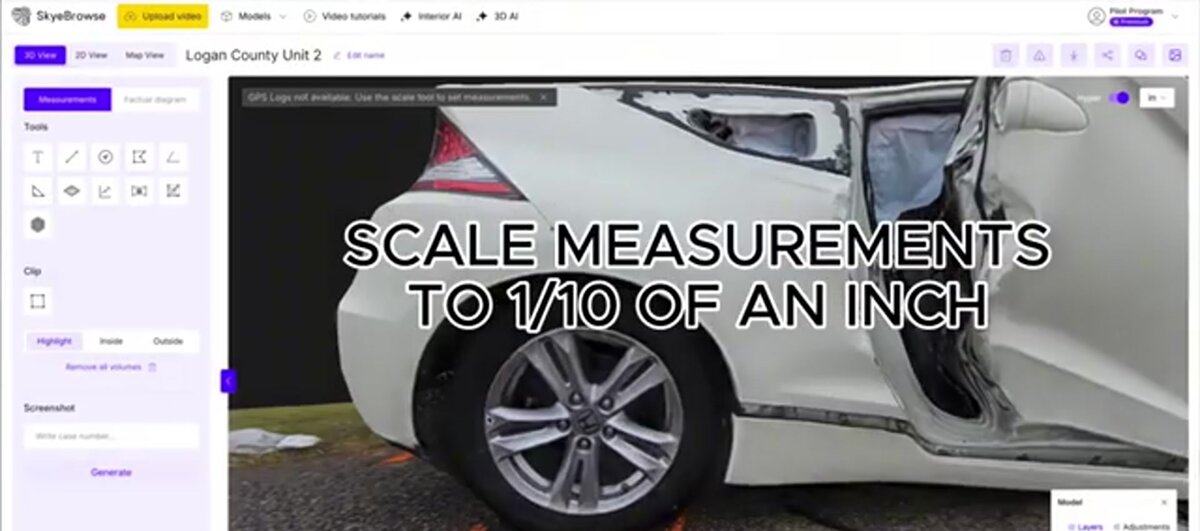
SkyeBrowse Premium delivers approximately 0.25-inch accuracy at 8K resolution, which is sufficient for spill extent measurements and containment planning. For EPA reportable quantity documentation and litigation-grade volume calculations, Premium Advanced provides 0.1-inch accuracy at 16K resolution with AI-assisted moving object removal.
The EPA's National Response Center requires precise documentation for reportable quantity releases — petroleum products, CERCLA hazardous substances, and other regulated materials. Volume calculations depend on accurate elevation models that reveal pooling zones, drainage flow directions, and spill boundaries. A model with 0.25-inch or better ground resolution provides the spatial fidelity needed for those calculations.
Premium Advanced's 16K processing takes that further by removing moving objects (vehicles, personnel) from the scene during reconstruction, producing a cleaner base model for volume analysis. The LAZ point cloud export — a standard LiDAR exchange format — loads directly into plume modeling software like ALOHA (NOAA/EPA's Areal Locations of Hazardous Atmospheres tool) and CAMEO. Modelers use actual terrain geometry from the SkyeBrowse model rather than simplified assumptions, improving vapor dispersion estimates and protective action zone accuracy.
For multi-agency responses involving local hazmat teams, state environmental agencies, EPA, and Coast Guard, all parties access the same georeferenced dataset. That shared spatial reference eliminates conflicting interpretations of spill extent and supports coordinated response decisions. The best CJIS compliant mapping platform guide covers how secure cloud access controls work across multi-agency public safety responses.
What does secure hazmat scene data look like for regulatory and legal purposes?
SkyeBrowse stores incident models on AWS GovCloud (US) infrastructure meeting FedRAMP Moderate standards. Premium tiers include five-year guaranteed model retention with full audit trails, supporting EPA enforcement timelines and both civil and criminal litigation requirements.
Superfund actions and natural resource damage assessments can emerge years after initial incidents. When EPA enforcement or private litigation surfaces, the original incident model provides verifiable evidence of spill extent, container conditions, and site geometry at the time of the response. Archived georeferenced models are far more defensible than field photographs because they capture spatial relationships that can be measured and independently verified.
Audit trails document every access event — which user viewed or downloaded a model, and when. For cost recovery litigation where responsible parties dispute initial conditions, that chain of custody establishes that the spatial evidence was preserved without modification. For criminal prosecutions arising from negligent releases, audit documentation supports evidentiary integrity arguments at trial.
Controlled sharing allows investigative parties to access models via secure links with permission-limited access. Custody transfer complications — physically transferring hard drives or dealing with proprietary file format incompatibilities — disappear when all parties access the same cloud-hosted dataset. This same data architecture benefits fire department drone operations for post-incident investigation and training review.
How does hazmat drone mapping fit into pre-incident planning?
Hazmat teams can use videogrammetry during non-emergency periods to document chemical storage facilities, tank farms, and process areas before incidents occur. Those pre-incident models give responders facility intelligence that compresses reconnaissance time when actual emergencies happen.
Pre-incident planning with aerial 3D models serves several operational functions. A georeferenced model of a facility's tank farm lets hazmat planners identify drainage pathways, measure distances between storage areas, and locate shutoff valve positions without requiring repeated site visits. When an incident occurs, responders arrive with spatial context they couldn't acquire during a time-pressured emergency.
Facility models also support mutual aid planning. Regional hazmat teams that rarely visit specific industrial facilities can review 3D site models during joint training exercises, building familiarity with chemical storage layouts and access routes before they're needed under pressure. The same model used for pre-planning serves as the baseline for damage assessment after an incident — comparing pre-incident and post-incident models reveals structural changes, container movements, and spill migration.
Post-incident critiques improve when spatial documentation is thorough. Reviewing the georeferenced model lets team leaders measure whether containment lines were placed optimally and quantify how spill migration compared to initial estimates. For teams exploring related emergency drone workflows, search and rescue drone mapping and best 3D mapping software for fire departments cover adjacent programs that often share the same equipment and operators.
Remediation contractors bidding cleanup projects benefit from the same models. Volume calculations from the 3D scene replace field-note estimates, reducing contingency pricing and improving cost recovery accuracy for responsible parties and agencies alike.
FAQ
Can drones safely fly over active hazmat spill sites?
Yes. Drones operate from upwind standoff positions outside the hot zone perimeter, so operators never enter contaminated areas. Many standard DJI and Autel platforms are appropriate for hazmat reconnaissance, and video uploads happen remotely after landing. Check SkyeBrowse's supported drones list to confirm compatibility with your current equipment.
What accuracy level do hazmat teams need for spill volume calculations?
For EPA reportable quantity documentation, SkyeBrowse Premium delivers approximately 0.25-inch accuracy at 8K resolution — sufficient for spill extent measurements and containment planning. Premium Advanced at 16K and 0.1-inch accuracy is recommended when precise volume calculations are required for regulatory reporting or litigation. Pricing details are available at skyebrowse.com/pricing-premium.
How long does it take to generate a 3D model from a hazmat drone flight?
Processing time on SkyeBrowse closely tracks flight duration. A 10-minute reconnaissance flight returns a complete georeferenced 3D model in approximately 10 minutes, giving incident commanders actionable spatial data fast enough to influence real-time containment decisions rather than post-incident review.
Is hazmat scene data stored securely for EPA enforcement or litigation?
SkyeBrowse hosts data on AWS GovCloud (US), which meets FedRAMP Moderate authorization standards. Premium tiers include five-year guaranteed model retention with audit trails recording every access event. That combination supports EPA enforcement timelines and the evidentiary integrity requirements of both civil and criminal litigation arising from hazardous material releases.