Judges and juries are not engineers. When a case hinges on where two vehicles were at the moment of impact, or how fire spread through a structure, spatial evidence presented as a flat photograph or a hand-drawn diagram often fails to communicate what actually happened. 3D model viewers for court — platforms that let attorneys, expert witnesses, and juries navigate photorealistic spatial reconstructions — have become a critical part of litigation involving accident reconstruction, crime scenes, and property disputes. The viewer you choose determines whether your spatial evidence survives authentication challenges and actually reaches the fact-finder intact.
Key Takeaways
- 3D models qualify as demonstrative exhibits under Federal Rules of Evidence 401-403 when authenticated through foundation testimony covering capture methodology, processing accuracy, and scene conditions.
- Web-based viewers that require no software installation eliminate the most common courtroom technology failure: incompatible court computer systems.
- Videogrammetry — the process of deriving 3D geometry from video rather than individual photos — allows investigators to capture a scene in 15-20 minutes versus 3-4 hours with traditional survey methods, while generating the same defensible spatial record.
- Accuracy tiers matter: sub-inch models (0.1-0.25 inch) support precise measurement testimony; inch-range models (2-6 inch) are appropriate for spatial relationship and sightline analysis.
- Authentication is won before trial — through metadata logs, accuracy verification, and chain-of-custody records created at capture time, not assembled afterward.
Contents
- What evidence rules govern 3D models in court?
- What should you look for in a courtroom 3D viewer?
- How do different viewer platforms compare for litigation use?
- How does expert testimony work with 3D spatial evidence?
- What does foundation testimony need to cover?
- FAQ
What evidence rules govern 3D models in court?
3D models are governed by Federal Rules of Evidence 401-403 as demonstrative exhibits, and authentication is required under FRE 901. A model is admissible when a qualified witness can testify that it accurately represents the scene and helps the trier of fact understand a disputed issue. Courts reject models that misrepresent spatial geometry, introduce speculative elements, or cannot be verified against independent measurements.
Federal Rule of Evidence 401 requires that evidence have a tendency to make a disputed fact more or less probable. For spatial evidence — the distance between two vehicles, the sightline available to a driver, the point of origin in a structure fire — a properly authenticated 3D model typically satisfies this standard more convincingly than photos or diagrams alone.
FRE 403 gives courts discretion to exclude evidence whose probative value is substantially outweighed by unfair prejudice. Opponents sometimes argue that photorealistic 3D models are so visually compelling they prejudice jurors when methodology is disputed. Courts have generally rejected this when the model is grounded in measurable data rather than artistic reconstruction, but it remains an issue to address in foundation testimony.
Daubert challenges apply when a 3D model is offered alongside expert opinion testimony. Under Daubert v. Merrell Dow Pharmaceuticals, expert methodology must be testable, have known error rates, and be generally accepted in the relevant field. Photogrammetry and videogrammetry — the processes of deriving 3D geometry from images or video — satisfy these standards, with accuracy benchmarks documented by the American Society for Photogrammetry and Remote Sensing (ASPRS).
What should you look for in a courtroom 3D viewer?
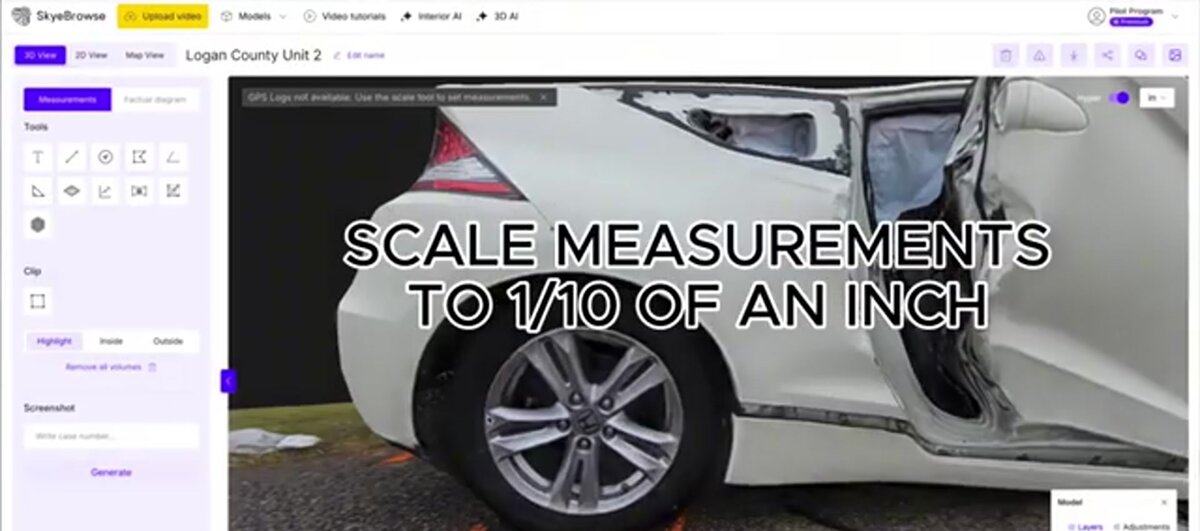
The best viewer for courtroom use is one that works reliably on equipment you do not control, requires no software installation, and lets non-technical users navigate the model without assistance. It should display embedded measurements, support shareable links or downloadable exhibit files, and generate the metadata logs that authentication testimony requires.
Courtroom technology failures are more damaging than having no technology at all. If your demonstrative exhibit freezes, requires a plugin the judge's laptop won't install, or needs a specialized graphics card, you lose the moment and sometimes the jury. Web-based viewers that run in a standard browser solve this problem entirely — they work on any device with internet access, including courtroom display systems and remote video deposition platforms.
Measurement display is the second critical feature. A viewer that can show the jury a specific distance — the 180-foot braking distance the expert testified to, measured and embedded in the model — is far more persuasive than a witness reading from a report. The measurement should tie to verifiable field data, not a post-processing estimate.
For remote depositions and pre-trial discovery, a shareable link that opposing counsel can independently access and navigate demonstrates transparency. Sharing the model early allows opposing experts to scrutinize the methodology and, in most cases, confirm its accuracy.
How do different viewer platforms compare for litigation use?
Web-based viewers built for public safety, like SkyeBrowse, offer the best combination of no-install access, embedded measurements, and chain-of-custody metadata for litigation. Specialized forensic desktop software provides deep analytical tools but requires licensing and installation. PDF 3D and VR platforms are generally unsuitable for routine courtroom use due to compatibility and authentication complexity.
| Viewer Type | Courtroom Fit | Key Limitation |
|---|---|---|
| Web-based (SkyeBrowse) | Works on any browser; shareable link; embedded measurements | Requires internet access during presentation |
| Forensic desktop software | Deep analysis tools; accepted in specialized expert contexts | Requires installation; licensing; IT support |
| PDF 3D (Adobe) | Can be filed as exhibit document | File size limits; viewer compatibility varies; limited interactivity |
| VR/AR platforms | Immersive; powerful for site-visit substitution | Equipment required; authentication complexity; potential prejudice arguments |
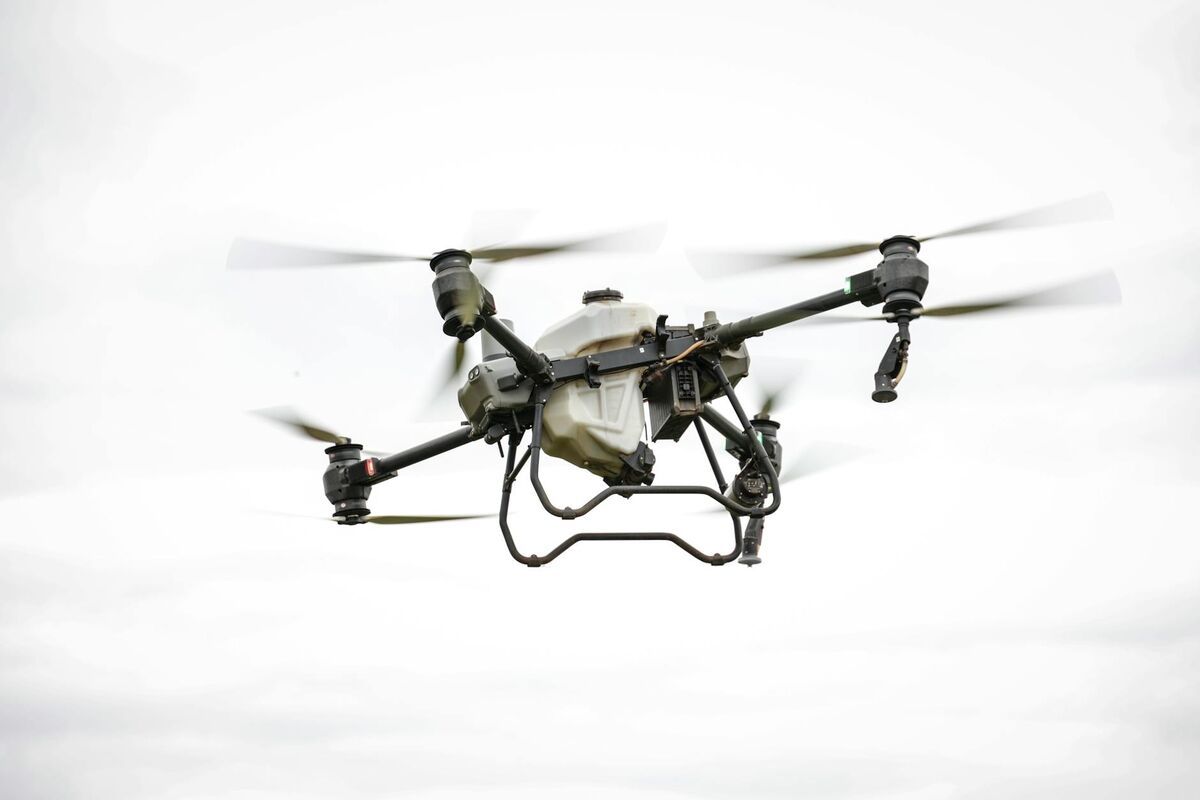
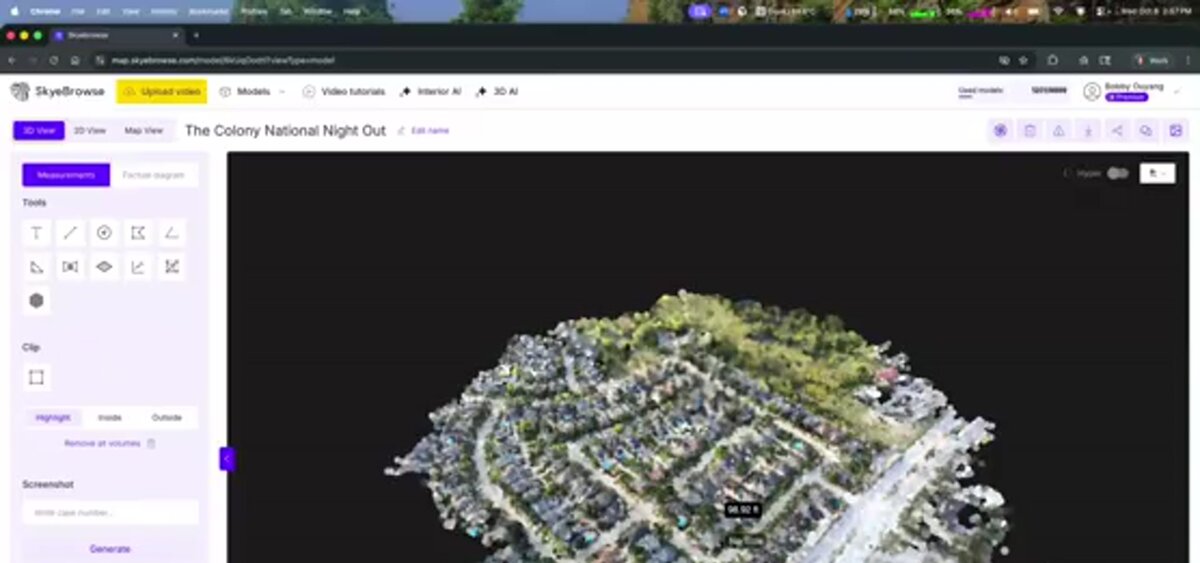
SkyeBrowse is a cloud-based videogrammetry platform used by more than 1,200 public safety agencies. It processes drone or phone video into navigable 3D models, so investigators can capture a scene in 15-20 minutes and have a court-ready spatial record within hours. The model is accessible at a shareable URL — no software installation required on the courtroom display system.
For attorneys evaluating options, the workflow matters as much as the viewer. Platforms that require specialists to operate, take days to process, or output proprietary file formats create authentication friction. Platforms with documented processing pipelines and exportable accuracy metadata are far easier to authenticate. See the videogrammetry vs photogrammetry breakdown and the forensic engineering guide for capture technology context.
How does expert testimony work with 3D spatial evidence?
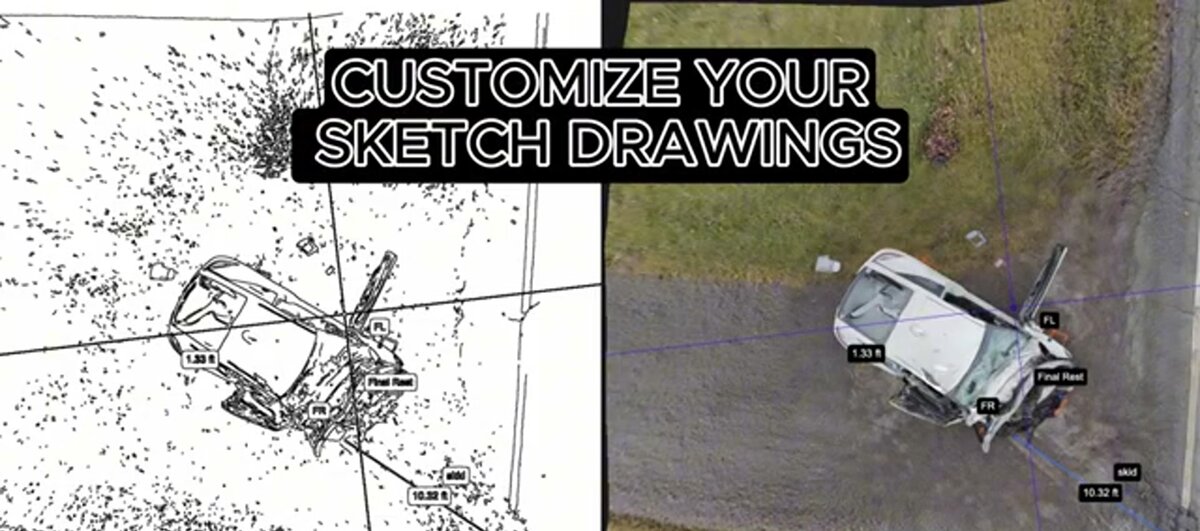
An expert witness uses the 3D model to make abstract spatial calculations tangible to a lay jury. Rather than asking jurors to visualize a 180-foot braking distance from verbal testimony, the expert can show the jury that distance in the model — where the vehicle was, where the obstacle was, and how much space separated them. The model becomes a visual anchor for the expert's opinion.
Expert witnesses in accident reconstruction and crime scene cases routinely deal with a comprehension gap: their analysis is technically sound, but the underlying spatial reasoning is invisible to a jury without an engineering background. 3D models close that gap in a way that photographs and diagrams cannot.
Consider a vehicular homicide case with a disputed sightline. The defense argues that vegetation along a rural curve blocked the driver's view of a pedestrian. The prosecution's reconstructionist can show in the 3D model exactly what was visible from the driver's eye position and at what distance the pedestrian entered the sight cone. Jurors see the spatial relationship directly instead of inferring it from verbal testimony.
When opposing experts attack measurements and methodologies, a 3D model with embedded field-verified measurements is far more difficult to undermine than diagrams or estimated positions. The best accident reconstruction software guide covers how accuracy tiers affect admissibility arguments. The best crime scene documentation equipment article covers complementary tools that round out the evidentiary record.
What does foundation testimony need to cover?
Foundation testimony for a 3D model must establish five things: how and when video was captured relative to the incident, what photogrammetric method was used to process it, what accuracy the method achieves and how that was verified, whether scene conditions changed between incident and capture, and specifically how the model helps the jury understand the facts at issue.
Prepare expert witnesses to address each element before trial. Courts rarely exclude a well-documented 3D model, but witnesses who stumble on methodology questions under cross-examination create doubt that can undercut an otherwise sound exhibit.
Capture methodology: When was video captured relative to the incident? What device — drone, smartphone, or 360 camera — was used, and what are its documented specifications? Who performed the capture, and what is their training? Was chain of custody maintained from capture through processing?
Processing technique: What photogrammetric or videogrammetric method was used? What accuracy does the method achieve under the capture conditions present at the scene? Were ground control points used to improve georeferencing? How was the coordinate system verified?
Accuracy verification: How was model accuracy validated? What control measurements were taken in the field, and do they match model measurements within the claimed tolerance? For litigation requiring sub-inch accuracy, platforms like SkyeBrowse offer Premium Advanced processing that achieves approximately 0.1-inch spatial accuracy — a level documentable through the platform's metadata and verifiable by opposing experts.
Scene preservation: Had conditions changed between the incident and capture? Vegetation grows, road markings fade, and debris is removed. Foundation testimony must account for any changes and explain what, if anything, is reconstructive rather than directly measured.
Relevance: How does this specific model help the jury understand the facts at issue in a way that photographs or diagrams cannot? This is the closing argument for admissibility, and it should be specific to the spatial question the case turns on.
For public safety agencies already using SkyeBrowse in the field, the best 3D mapping software for police guide covers how the same workflow that captures scene data also builds the documentation foundation for courtroom use.
FAQ
Are 3D models admissible as evidence in court?
Yes. 3D models are admissible as demonstrative evidence under Federal Rules of Evidence 401-403 when properly authenticated. The proponent must establish how the model was created, what data sources were used, what accuracy was achieved, and whether it fairly represents conditions at the relevant time. Courts have admitted them in accident reconstruction, crime scene, and property dispute cases across state and federal jurisdictions.
What makes a 3D model viewer suitable for courtroom use?
A courtroom-suitable viewer needs to operate without software installation on court equipment, display embedded measurements verifiable against field data, allow non-technical jurors and judges to navigate intuitively, and support a shareable link or exportable file for submission as an exhibit. Web-based platforms are generally preferred because they eliminate the most common courtroom technology failure: incompatible software environments. See how SkyeBrowse's browser-based viewer works at app.skyebrowse.com.
How accurate does a 3D model need to be for litigation?
Accuracy requirements depend on what the spatial evidence must prove. For sightline and spatial relationship analysis, inch-level accuracy is typically sufficient. For cases involving precise measurements — stopping distances, lane widths, structural dimensions — sub-inch accuracy strengthens foundation testimony. SkyeBrowse Premium processing achieves approximately 0.25-inch accuracy; Premium Advanced achieves approximately 0.1-inch accuracy, both documentable through platform metadata for Daubert review.
Can opposing counsel challenge a 3D model in court?
Yes. Opposing counsel can challenge authentication under FRE 901 by questioning data collection methods, processing accuracy, scene conditions at capture, and the creator's qualifications. Platforms that generate timestamped metadata logs, export accuracy reports, and support documented chain of custody make these challenges significantly harder to sustain. The documentation is created at capture time — assembling it after the fact raises its own authentication issues.