Campus safety operations manage some of the most complex built environments in the public safety sector — dozens or hundreds of buildings, sprawling outdoor zones, and thousands of occupants whose layouts change every semester. 3D mapping software for campus safety translates that physical complexity into navigable spatial intelligence that campus police, local first responders, and emergency planners can act on before an incident happens. Videogrammetry — the process of converting video footage into georeferenced 3D models — has made this kind of documentation fast enough and affordable enough for university public safety departments to build and maintain their own spatial library.
Key Takeaways
- Campus emergency operations plans mandated by the Department of Education require spatial documentation that static floor plans and written procedures cannot adequately provide.
- Video-based building documentation costs 90–95% less than hiring external security consultants for equivalent spatial assessments — roughly $200–$400 per building versus $5,000–$10,000.
- Pre-built 3D campus models shared with local law enforcement reduce officer orientation time during active threat responses, improving tactical decision speed.
- SkyeBrowse's cloud-based platform is used by more than 1,200 public safety agencies and stores data on AWS GovCloud infrastructure with CJIS-focused access controls on premium tiers.
- Incident scene models captured within hours of a report provide defensible spatial records for Clery Act compliance, Title IX investigations, and civil litigation defense.
Contents
- Why do campus safety teams need 3D mapping instead of floor plans?
- How does campus safety drone mapping work in practice?
- Which tools are the best fit for educational institutions?
- How does 3D mapping support active threat response planning?
- How does spatial documentation support Clery Act compliance and campus investigations?
- FAQ
Why do campus safety teams need 3D mapping instead of floor plans?
Floor plans and architectural drawings represent how a building was designed, not how it exists today. After years of renovations, furniture changes, and temporary constructions, what's on paper rarely matches what an officer encounters on entry. 3D models built from current video footage show the building as it actually stands — including obstructions, access points, and layout details that standard drawings miss.
The U.S. Department of Education requires colleges and universities to maintain emergency operations plans covering shelter-in-place, evacuation, and active threat scenarios. Those plans are only as useful as the spatial intelligence behind them. When a responder is briefed on a floor plan that's three renovations out of date, the plan becomes a liability instead of an asset.
Traditional documentation methods — paper floor plans, 2D CAD drawings, and written security checklists — are also difficult to share and interpret under stress. A navigable 3D model accessible on a tablet or patrol laptop gives a responding officer the same spatial orientation as someone who has physically walked every floor.
Campus security assessments face the same gap. A 3D perimeter model reveals clusters of vulnerabilities — concealment opportunities, broken lighting, unsecured access points — in spatial context that no set of individual photographs can convey.
How does campus safety drone mapping work in practice?
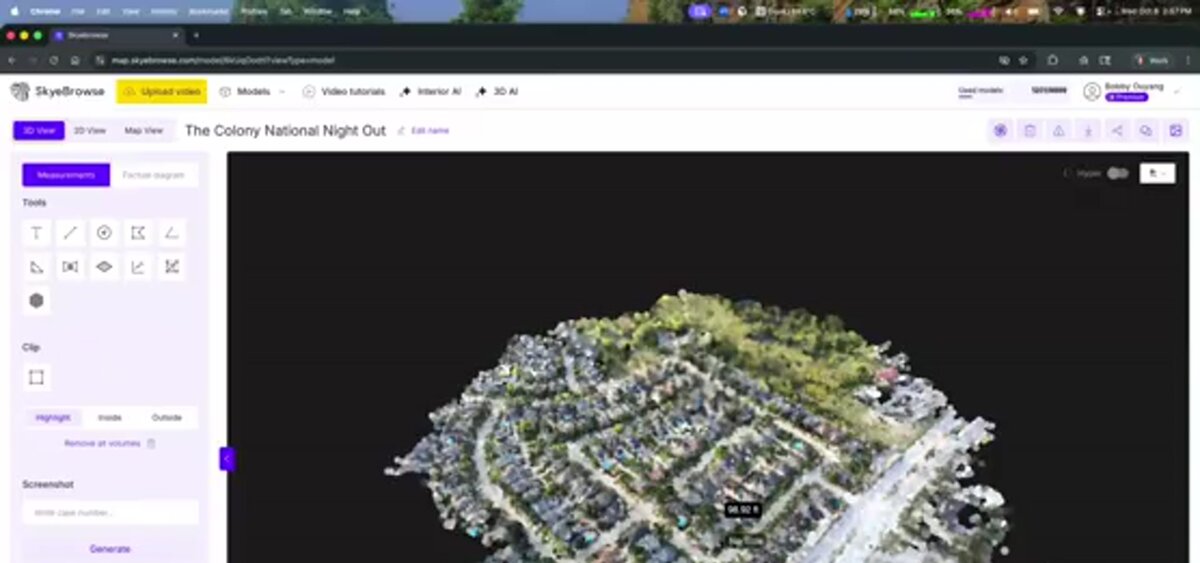
Exterior campus areas are captured with a drone flying an orbital or perimeter pattern around buildings, parking structures, and open security zones. Interior spaces are documented by walking the building with a smartphone or action camera, recording a continuous 3-to-5-minute video of each floor. Both video types upload to a cloud platform for processing into a fully navigable 3D model — no specialized equipment or GIS expertise required.
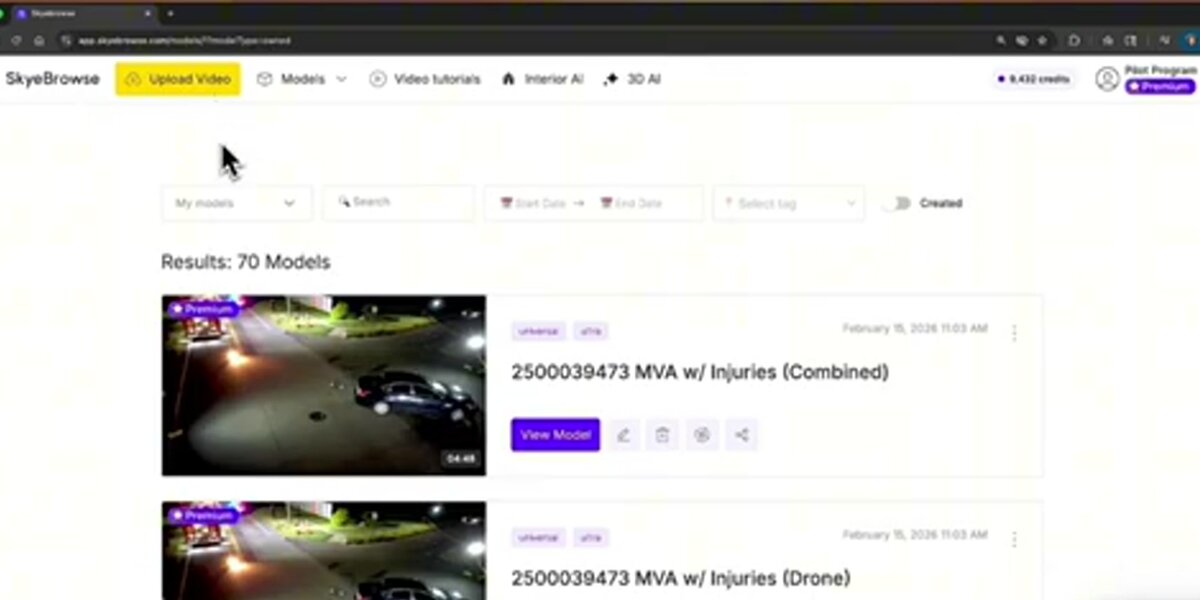
SkyeBrowse accepts .MP4 and .MOV files uploaded directly through the web dashboard at app.skyebrowse.com or via the SkyeBrowse Flight App for drone-captured footage. For exterior mapping, telemetry files (.SRT from DJI drones, .ASS from Autel) pair with the video to improve georeferencing accuracy. For interior walkthroughs, no telemetry is needed — the video alone generates a navigable model of the space.
Processing happens in the cloud, meaning campus police don't need desktop workstations or specialized hardware. A facilities staffer or campus officer walking a building during normal access hours generates the source material. The resulting model can be shared via secure link with local law enforcement, mutual aid partners, or emergency planning staff — giving every stakeholder the same spatial picture before an incident requires it.
For a campus with 80 buildings, annual model refresh cycles allow the spatial library to stay current without consuming significant staff time. The cost difference compared to external consultants is substantial. At $200–$400 per building for processing versus $5,000–$10,000 for a consultant-led spatial assessment, a campus operating its own documentation program saves roughly 95% while retaining the models internally for immediate access.
Which tools are the best fit for educational institutions?
The best campus safety mapping tools combine fast processing, secure cloud storage, and shareable outputs — not the maximum feature count. Tools designed for construction or GIS analysis often require training and hardware that campus police departments don't have. Video-to-3D platforms purpose-built for public safety workflows close that gap without requiring a dedicated GIS analyst.
Here is how the major options compare for educational institutions:
| Technology | Campus Safety Application | Implementation Reality |
|---|---|---|
| Video mapping (SkyeBrowse) | Building interiors, exterior security zones, emergency access routes | Smartphone or drone capture, rapid cloud processing, shareable with responding agencies |
| Traditional CAD / floor plans | Architectural records, construction reference | Often outdated, no spatial context for responders, not accessible in the field |
| 360-degree virtual tours | Recruitment, campus marketing | Insufficient measurement accuracy for emergency planning, not designed for tactical use |
| Ground LiDAR scanners | High-precision interior surveys | Expensive hardware, slow capture, limited to trained operators |
| Desktop photogrammetry software | Research-grade 3D reconstruction | Significant processing time, steep learning curve, not designed for rapid operational use |
SkyeBrowse sits at the intersection of speed and accuracy that campus safety operations require. Its Lite tier produces models with approximately 2–6 inch accuracy — sufficient for emergency familiarization and security zone documentation. Premium tier outputs reach approximately 0.25 inch accuracy, appropriate for incident scene documentation that may enter legal proceedings. The platform's data is hosted on AWS GovCloud infrastructure, a requirement many university legal and IT offices expect for public safety data.
For departments already using SkyeBrowse for accident reconstruction or crime scene documentation, see the best 3D mapping software for police guide and the best CJIS compliant mapping platform comparison for details on compliance tiers.
How does 3D mapping support active threat response planning?
Officers responding to an active assailant call on a campus they have never entered are operating at a significant disadvantage. Pre-built 3D models of campus buildings — shared with local law enforcement in advance — let officers review stairwell locations, room connectivity, hallway dead ends, and evacuation routes before they arrive on scene, reducing the time spent orienting under pressure.
The International Association of Campus Law Enforcement Administrators (IACLEA) recommends that campus emergency operations plans be coordinated with local law enforcement agencies and include building-specific familiarization components. 3D models hosted on a cloud platform fulfill that requirement in a format that patrol officers can access on a laptop or tablet during low-activity shifts.
Tabletop exercises benefit from the same resources. Participants working from a navigable 3D model understand the room layout, distances to exits, and line-of-sight constraints — improving learning outcomes compared to abstract floor plan references.
Pre-loaded models on patrol tablets give responding officers immediate spatial reference during approach — letting them orient to the structure before entry rather than relying on a building escort. The search and rescue operations article covers related situational awareness workflows that also apply to large campus outdoor scenarios.
How does spatial documentation support Clery Act compliance and campus investigations?
The Clery Act requires institutions to document campus crimes accurately and maintain records that can withstand audit. When an incident is reported near a building entrance, in a parking structure, or in a common area, a 3D model captured within hours documents the spatial conditions — lighting, sightlines, proximity to emergency call boxes, access routes — before anything changes. That documentation creates a defensible record for both the institution and any subsequent investigation.
Title IX and Student Conduct investigations require establishing where events occurred and what physical conditions existed at the time. Campus police can document an incident location with a smartphone walkthrough in under 10 minutes, producing a model with measurement tools, navigable views, and a shareable format that investigators and legal counsel can access without specialized software.
For departments that need to understand how spatial documentation intersects with broader forensic workflows, the drone forensic engineering article covers the evidentiary standards that apply when materials may enter legal proceedings.
FAQ
What is the best 3D mapping software for campus safety?
SkyeBrowse is built specifically for public safety use cases and is deployed by more than 1,200 agencies worldwide. Its cloud-based videogrammetry workflow — converting drone or smartphone video into navigable 3D models — handles both the scale of a multi-building campus and the speed requirements of incident documentation. For departments comparing options, the best 3D mapping software for police guide covers the broader public safety platform landscape.
Can drones be used for campus security mapping?
Yes. Campus police and university public safety departments use drones to capture exterior security zones, building perimeters, and parking structures. A drone flight around a dormitory complex or academic building captures geometry and spatial relationships that no ground-level walkthrough can replicate. The resulting exterior 3D model complements interior smartphone walkthroughs for complete building coverage.
Does campus 3D mapping help with Clery Act compliance?
Models captured shortly after an incident provide defensible documentation of spatial conditions at the time of the report. This supports both internal investigations and the recordkeeping requirements the Clery Act imposes. Unlike photographs, a 3D model allows investigators to take measurements, reconstruct sight lines, and review the scene from any angle — producing documentation that holds up in both administrative and civil proceedings.
How much does campus safety 3D mapping cost?
External security consultants typically charge $5,000–$10,000 per building for detailed spatial assessments. Video-based processing through a platform like SkyeBrowse runs approximately $200–$400 per building. Across an 80-building campus, the difference approaches $400,000–$800,000 versus $16,000–$32,000 — and the internal model library remains accessible to campus police at any time, without scheduling an outside firm.