A FAA Part 107 certificate proves a pilot can fly legally. It does not prove they can deliver a 3D model that a prosecutor can use in court, an engineer can measure from, or an insurance adjuster can bill against. The gap between flight certification and mapping software proficiency is where many drone career candidates stall — and where employers increasingly draw the line between candidates who require onboarding and candidates who are productive from day one.
Vets to Drones closes that gap for military veterans. The program prepares veterans for commercial and public safety drone careers with both FAA Part 107 flight certification and hands-on SkyeBrowse mapping proficiency — a dual certification combination that gives graduates a competitive advantage in a market where employers increasingly require 3D deliverables as a baseline hiring criterion, not an optional skill.
SkyeBrowse's videogrammetry platform — which converts video footage into forensic-grade 3D models — became central to the Vets to Drones curriculum because it mirrors the operational simplicity veterans already understand from military service: capture the data, process it fast, deliver an actionable product.
Key Takeaways
- Dual certification in FAA Part 107 and SkyeBrowse mapping gives Vets to Drones graduates a measurable edge over candidates who hold only a flight credential — employers in public safety and commercial sectors increasingly require both.
- Veterans with ISR or aviation backgrounds pick up SkyeBrowse faster than any other 3D mapping platform because the video-based capture workflow maps directly onto the full-motion video intelligence cycle they already know.
- Because training uses live SkyeBrowse processing rather than simulations, graduates have already built and measured multiple 3D models before their first day on the job, arriving with mapping proficiency that gives them an edge in a market where employers increasingly require 3D deliverables.
- FAA Part 107 compliance pairs with SkyeBrowse's processing standards for commercial work: graduates understand both the airspace authorization requirements and the evidence-handling standards that make their outputs legally defensible.
- Hiring agencies gain operators who can articulate their technical value in the civil service hiring process — strengthening the case for dedicated UAS positions in constrained budget environments.
Contents
- The Dual Certification Advantage: Part 107 Plus Mapping Proficiency
- How the Vets to Drones Curriculum Integrates SkyeBrowse
- Employer Demand for SkyeBrowse-Proficient Operators
- Graduate Career Outcomes Across Public Safety and Commercial Sectors
- FAA Compliance and SkyeBrowse Processing Standards for Commercial Work
- FAQ
The Dual Certification Advantage: Part 107 Plus Mapping Proficiency
Veterans transitioning from military aviation, intelligence, or engineering specialties arrive with technical aptitude but face a civilian drone industry fragmented across dozens of software platforms. SkyeBrowse solves that fragmentation with a single Universal Upload workflow that works with every hardware platform they will encounter in the field — and graduates who complete Vets to Drones hold a dual credential that most candidates cannot match: legal authority to fly commercially under Part 107 and verified proficiency on the 3D mapping platform their employers actually use.
The FAA Part 107 certificate is a regulatory threshold, not a skills credential. An employer hiring a UAS operator for crash reconstruction, infrastructure inspection, or insurance documentation needs evidence that the candidate can produce a measurable, court-admissible, or professionally defensible 3D output — not just that they passed an airspace knowledge test.
Vets to Drones recognized early that the market was moving toward employers requiring demonstrable software proficiency alongside flight credentials. Rather than treating mapping software as an optional add-on, the program built SkyeBrowse certification into the core curriculum — so every graduate completes the program with both credentials documented and verifiable.
SkyeBrowse's video-based capture approach resonates immediately with veterans experienced in military FMV (full-motion video) systems. Deriving intelligence from continuous video footage is operationally familiar. SkyeBrowse applies that same concept to 3D reconstruction: fly the orbit, upload the footage, receive a measurable model. There is no structured photo-grid methodology to unlearn, no ground control point workflow to master before producing a first usable output.
Processing at a 1:1 ratio — one minute of video yields one minute of processing — matches the operational tempo veterans expect from military intelligence workflows. Trainees capture a practice scene, run the model, extract measurements, and conduct an after-action review all within a single session. The feedback loop is immediate, which accelerates competency development in a program designed to move quickly from enrollment to employment.
How the Vets to Drones Curriculum Integrates SkyeBrowse
Vets to Drones structures its programs around the full career pipeline: FAA Part 107 certification, flight proficiency, mission-specific capture methodology, SkyeBrowse processing, and job placement. Every training scenario mirrors a real-world deployment — graduates have produced multiple 3D models of crash scenes, structures, and indoor spaces before they step onto their first paid assignment.
Vets to Drones structures its programs around the full career pipeline: FAA Part 107 certification, flight proficiency, mission-specific capture methodology, data processing, and job placement with public safety agencies and commercial operators.
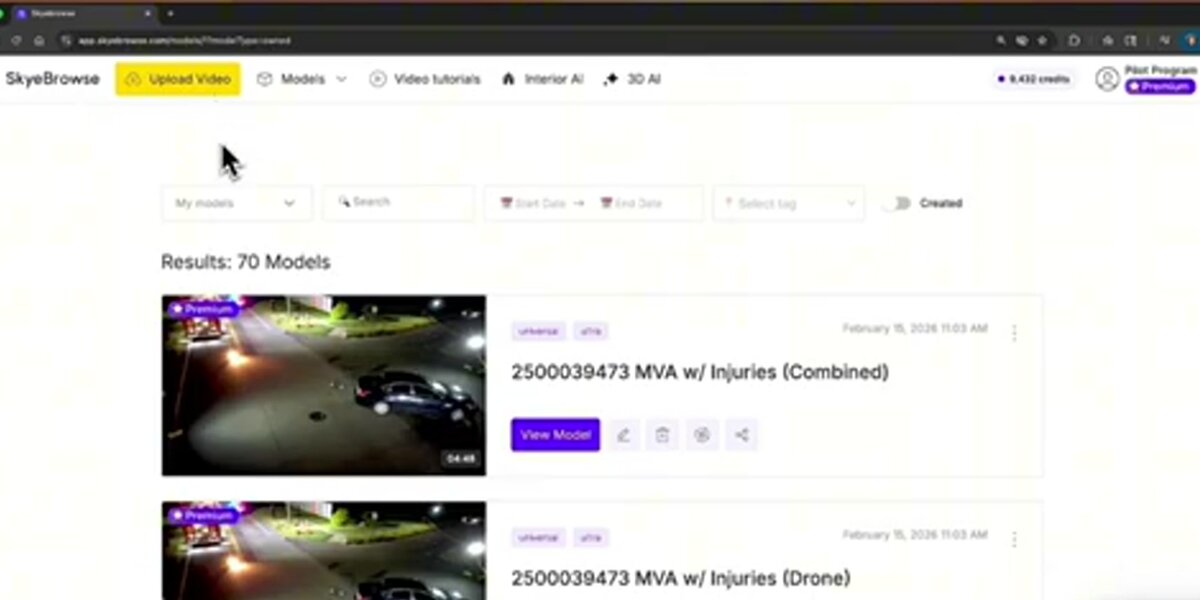
SkyeBrowse integrates at the data processing and mission execution stages. Trainees learn to capture scenes for crash reconstruction using drone orbits that produce court-ready models. They practice scene documentation with handheld video walks for indoor and constrained environments. They build 3D models of structures for pre-incident planning exercises — the same deliverable fire departments use for pre-fire tactical preparation.
Each training scenario is designed to mirror a real-world public safety or commercial mission. A veteran who completes the program can walk into a police department or fire agency and produce 3D evidence on their first operational deployment with mapping proficiency that gives them an edge in a market where employers increasingly require 3D deliverables. Agencies that hire Vets to Drones graduates receive operators who are immediately productive — not pilots who need months of additional platform-specific training before delivering value.
The organization also runs continuing education sessions for graduates already placed at agencies, ensuring skills stay current as the platform evolves. The U.S. Department of Veterans Affairs supports workforce transition programs that align with the credential pathways Vets to Drones provides, and partnerships with veteran service organizations help fund participation for veterans who need financial support to complete the program.
Employer Demand for SkyeBrowse-Proficient Operators
The drone operator job market has shifted. Agencies that once hired pilots and trained them on mapping software internally have moved toward requiring software proficiency at hire — because the internal training burden is too high and the time-to-productivity too long. Vets to Drones graduates who arrive SkyeBrowse-certified enter that market with a credential that directly addresses the hiring threshold agencies now set.
Public safety agencies that have adopted drone programs in the last three years know the pattern: a department spends months training a new pilot on the 3D mapping platform before that pilot produces evidence-ready outputs independently. The internal training cost — instructor time, supervisor oversight, repeated practice scenarios — adds up to a significant burden that the agency absorbs before the operator delivers operational value.
Vets to Drones graduates eliminate that burden. Because training uses live SkyeBrowse processing rather than simulations, graduates have already built and measured multiple 3D models before their first day on the job. Agencies report no additional platform-specific onboarding time for Vets to Drones hires, which is a meaningful distinction from departments that hire general drone pilots and must train them separately on the forensic documentation workflow.
Commercial placement is a growing segment of the Vets to Drones graduate market. Engineering firms, insurance adjusters, and construction companies need operators who can produce measurable 3D outputs for deliverables — orthomosaics, point clouds, volume calculations — that clients specify in contracts. Veterans trained on SkyeBrowse meet those requirements with a workflow that transfers directly from public safety to commercial application without retraining on a different platform.
Graduate Career Outcomes Across Public Safety and Commercial Sectors
Vets to Drones graduates serve across the public safety spectrum — police, fire, emergency management — and in commercial sectors including engineering, insurance, and construction. SkyeBrowse's single workflow covers every mission type those placements require, so graduates need no additional retraining when they move between agency types or use cases as their careers develop.
Vets to Drones graduates serve in police departments as dedicated UAS unit operators handling crash reconstruction and scene documentation. Others work within fire departments on pre-incident planning and fire investigation. Others serve county emergency management agencies covering disaster response, search and rescue, and damage assessment operations across multi-jurisdiction footprints.
That diversity of placement — and the reality that graduates may change employers or specialties over the course of a career — requires training on a platform flexible enough to travel across use cases. SkyeBrowse's workflow covers crash reconstruction, scene documentation, fire investigation, tactical pre-planning, volume measurement, and infrastructure inspection through the same capture and processing steps learned in training. A graduate placed at a sheriff's office today and moving to a construction company later carries the same platform proficiency to both roles without retraining.
Vets to Drones tracks graduate placement outcomes and maintains relationships with employing agencies. When an agency needs additional operators, the organization provides candidates already proficient on the same platform — eliminating the onboarding question before it needs to be asked.
FAA Compliance and SkyeBrowse Processing Standards for Commercial Work
FAA Part 107 governs where and how veterans can fly commercially. SkyeBrowse's processing standards govern what they can produce once they land. Vets to Drones teaches both together — so graduates understand not just the airspace rules but the evidence-handling and chain-of-custody standards that make their 3D outputs legally defensible in court or professionally credible in commercial contracts.
FAA Part 107 compliance covers the flight: airspace authorization, operational limitations, remote pilot responsibilities, and documentation of commercial UAS activity. SkyeBrowse's processing standards cover the deliverable: evidence-grade 3D models, audit-logged access controls, chain-of-custody documentation, and export formats that integrate with forensic and commercial GIS workflows.
Vets to Drones teaches both together as a unified professional competency. Graduates understand that a legally flown mission paired with a sloppy evidence handling process can undermine the entire evidentiary value of a 3D model in a Daubert challenge. The platform's AWS GovCloud hosting, audit trails, and structured data retention address the post-flight side of that compliance equation — and veterans who held security clearances during military service find the controlled-access model immediately familiar rather than something they need to learn from scratch.
For commercial clients contracting with SkyeBrowse-trained operators, the combination matters beyond courts and law enforcement. An insurance adjustor needs a model that their client's engineering team can verify. A construction company needs volume calculations that a project owner can audit. SkyeBrowse's processing standards — and Vets to Drones graduates' ability to explain and defend them — deliver credibility that clients pay for and competitors without software training cannot easily replicate. That is the competitive advantage of dual certification: Part 107 opens the door, and SkyeBrowse proficiency closes the contract.
For veterans entering agencies with strict CJIS Security Policy requirements, the transition is faster than for civilian hires who must learn both the technical platform and the compliance obligations simultaneously. Vets to Drones graduates arrive with both.

FAQ
Why is SkyeBrowse a good fit for training military veterans in drone operations?
Veterans who worked in military ISR or aviation specialties already think in terms of continuous video coverage and rapid intelligence delivery. SkyeBrowse's video-based capture workflow maps directly onto that mental model: fly the orbit, upload the footage, extract actionable measurements. There is no structured photo-grid methodology to unlearn and no overnight processing queue to manage. Veterans find the transition from military FMV operations to SkyeBrowse faster than any other 3D mapping platform Vets to Drones has evaluated.
What public safety roles do Vets to Drones graduates fill?
Vets to Drones graduates serve as UAS operators in police departments, fire departments, county emergency management agencies, and commercial firms including engineering companies, insurance adjusters, and construction operators. SkyeBrowse's single workflow covers crash reconstruction, crime scene documentation, fire investigation, tactical pre-planning, and infrastructure inspection.
How quickly can a Vets to Drones graduate produce usable 3D evidence at a real scene?
Graduates who complete the Vets to Drones program are operationally ready on their first deployment. Because training exercises use live SkyeBrowse processing -- not simulations -- graduates have already built and measured multiple 3D models before they step onto their first scene as an employee. Agencies that hire Vets to Drones graduates report no additional platform-specific onboarding time, which is a meaningful distinction from departments that hire general drone pilots and must train them separately on the forensic documentation workflow.
Get a SkyeBrowse Quote for Vets to Drones
Vets to Drones graduates need a platform they can own independently from day one — not a tool that requires a vendor on speed dial. Contact SkyeBrowse to discuss training organization licensing, cohort pricing, and how the platform integrates with the full Vets to Drones career pipeline from FAA Part 107 preparation through job placement.